7 best Eventbrite competitors in 2026: what Eventbrite actually costs, and when to leave
A head-to-head look at Eventbrite versus seven competitors, with verified US and UK fees, a test for whether the marketplace is earning its keep, and a switching checklist.
Eventbrite is not a bad product. It’s a well-built platform with the largest event marketplace in the world, and for a certain kind of organiser it’s the right answer. The problem is that most organisers pay marketplace prices without using the marketplace.
This piece is narrower than a general roundup. It’s about one decision: should you leave Eventbrite, and if so, for what. If you’d rather browse by event type, see our alternatives matched by what you run.
What Eventbrite actually costs
United States: 3.7% + $1.79 per paid ticket, plus 2.9% payment processing charged per order.
United Kingdom: 3.7% + £0.59 per paid ticket, plus 2.9% processing per order.
Free events carry no fees at all.
That works out as:
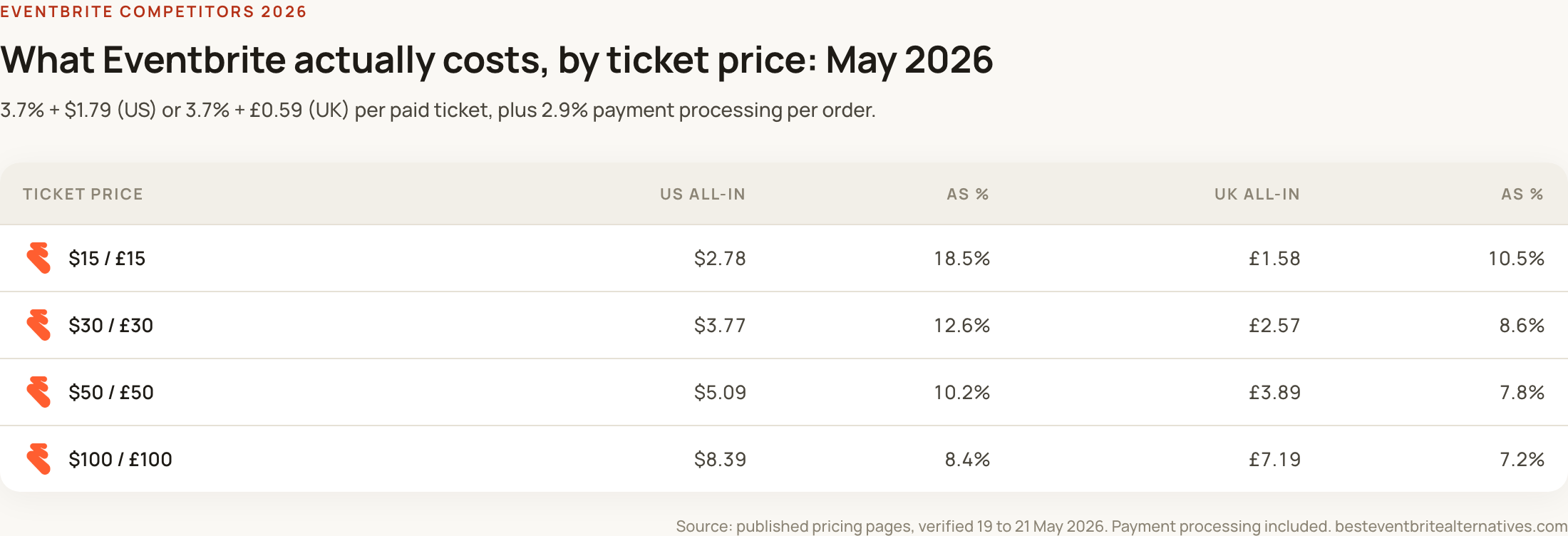
Two corrections to claims that circulate widely. Eventbrite’s UK rate is not “6.95%” or “roughly double the US” - the UK fixed fee of £0.59 is lower in absolute terms than the US $1.79. And the total is 8 to 18 per cent depending on ticket price, not a flat “10 to 14%”. On cheap tickets it’s worse than the usual claim; on expensive ones it’s better.
Note also that processing is charged per order, not per ticket, so an order of four tickets carries one processing charge. Most comparisons, including our tables, model single-ticket orders, which slightly overstates Eventbrite’s cost for group buyers.
The test: is the marketplace earning its fee?
This is the only question that matters, and you can answer it from your own Eventbrite reports rather than from an article.
Open your sales data and split buyers by source. How many arrived through Eventbrite’s own search, category pages and recommendations, versus through your email list, your Instagram, your website, a partner’s newsletter, or a poster?
- If most buyers came from Eventbrite’s own discovery, the fee is buying you something real. Stay, or at least stay for the events where that’s true.
- If most buyers came from your own channels, you are paying a discovery premium on traffic you generated. That’s the case for the majority of organisers we see, and it’s the case for switching.
A useful middle path: keep a small Eventbrite listing as a discovery channel for one or two events a year, and sell the rest through a cheaper platform. Nothing stops you running both.
The seven competitors, and what each swap gets you
1. Ticket Tailor - the straight cost swap
$0.30 per ticket prepaid or $0.65 pay as you sell in the US; £0.22 or £0.60 + VAT in the UK, plus your own Stripe, PayPal or Square processing.
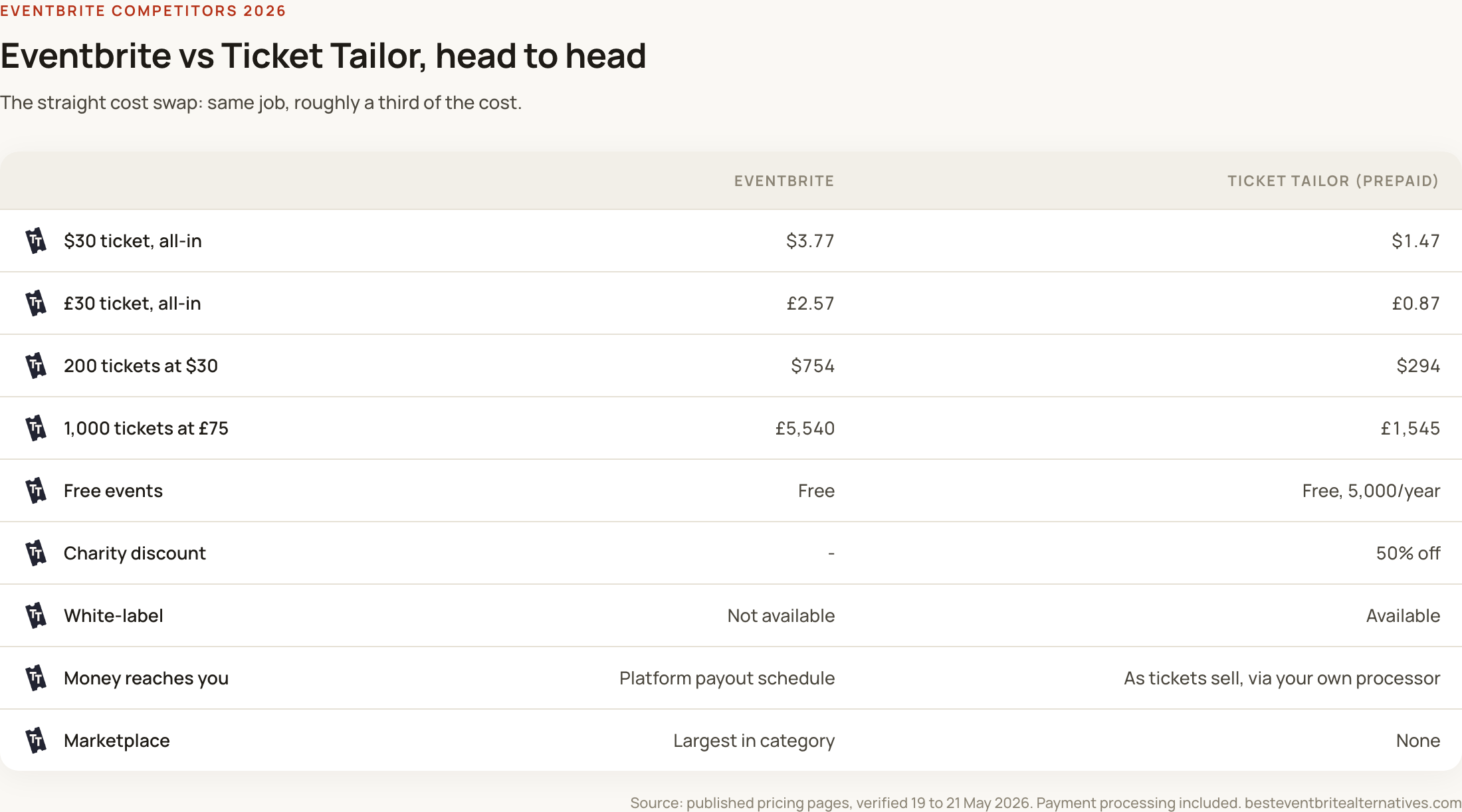
This is the swap most organisers are actually looking for: same job, roughly a third of the cost, and the money arrives during the sales window instead of after the event because your own payment processor holds it. It’s a B Corp, there’s no subscription at any tier, and the feature set covers reserved seating, recurring events and time slots, an offline-capable check-in app, embeddable checkout, gift cards, referral tracking, Meta and TikTok pixels, 96 currencies, Zapier, and native Mailchimp, HubSpot and ActiveCampaign integrations.
What you lose: discovery, and a native email marketing platform.
2. Zeffy - if you’re a US or Canadian nonprofit
$0, funded by optional buyer contributions. Against Eventbrite’s $754 on a 200-ticket $30 fundraiser, that’s the whole fee line gone. Registered 501(c)(3) or Canadian charity status required, US and Canada only.
3. Humanitix - if you want the fee to do something
2.1% + $0.99 in the US, 4.67% + £0.46 in the UK, with charity and school rates of 1% + $0.99 and 3.33% + £0.25. Cheaper than Eventbrite at every price point, and the booking fee profits fund children’s education programmes. It also has a genuine REST API with sandbox and webhooks, which Eventbrite’s current documentation makes harder to verify.
4. SimpleTix - if you sell seats
$0.79 + 2% online, capped at $9.99, $0.25 in person. The cap is the story: on a $500 seat SimpleTix charges $9.99 against Eventbrite’s $23 or so. Add a free seat-map builder, hold management, timed entry, Square integration and immediate payouts to your own merchant account. US only.
5. Weezevent - if you run a festival
2.5% + £0.99 UK or 2.75% + $0.99 elsewhere, with card processing bundled in. On a £45 concert ticket that’s £2.12 against Eventbrite’s £3.56, and across 800 tickets, £1,692 against £2,848. The real reason to switch is on-site: RFID cashless wristbands, mobile terminals, NFC access control and staff accreditation.
6. Universe - if you want Ticketmaster distribution
2.5% + $1.99 capped at $19.95 in the US, 5.5% + £0.99 capped at £9.95 in the UK, processing bundled. Owned by Ticketmaster, and its Pro tier offers Ticketmaster distribution, which no other independent platform here can. Cheaper than Eventbrite, though not dramatically. Worth knowing that Ticketmaster ownership is itself a reason some independent promoters rule it out.
7. TicketSource - if you’re a UK arts venue
7% + VAT bundled, or 4.5% + VAT with your own Stripe. Free events and in-person sales cost nothing, and TicketSource staff handle telephone bookings for your audience, which nothing else here does. Best on cheap tickets; expensive above about £20.
Head-to-head on three real events
200 tickets at $30 (US)
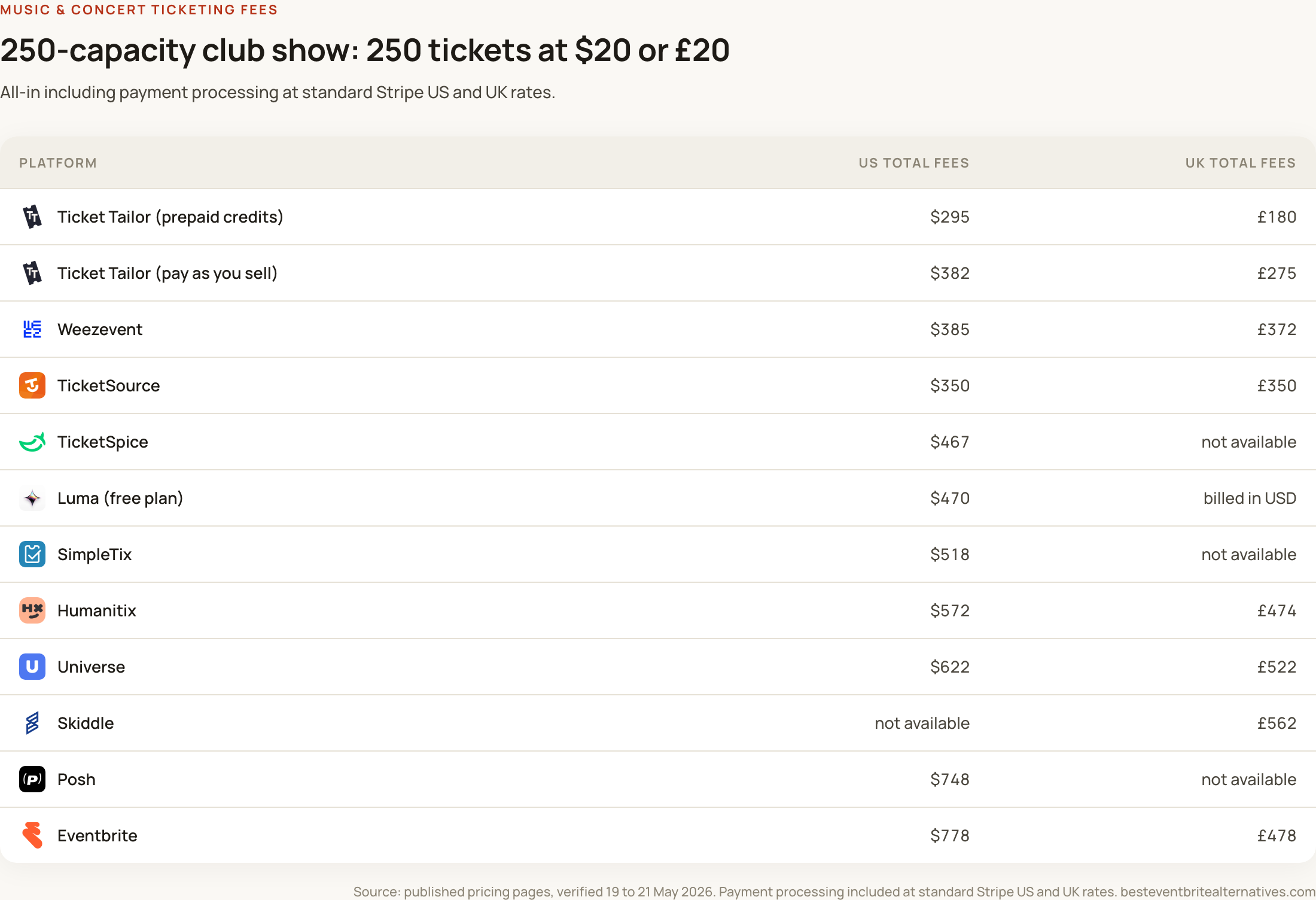
Ticket Tailor $294 · Weezevent $363 · TicketSpice $432 · SimpleTix $512 · Universe $548 · Humanitix $558 · Eventbrite $754
400 tickets at £25 (UK)
Ticket Tailor £318 · Weezevent £646 · TicketSource £680 · Humanitix £881 · Eventbrite £896 · Universe £946
300 tickets at $199 (US conference)
Ticket Tailor $1,911 · Weezevent $1,939 · Universe $2,090 · TicketSpice $2,118 · SimpleTix $3,252 · Eventbrite $4,477
The pattern holds across sizes and both currencies: the gap is roughly $400 to $500 on a small event, and $2,500 or more once you’re selling a few hundred higher-priced tickets.
Where Eventbrite genuinely wins
Being honest about this is the point of the exercise.
- Discovery at scale. No alternative comes close. Posh has nightlife, Luma has community calendars, Humanitix and Universe have modest marketplaces. If your event category is browsed rather than searched, Eventbrite is where the browsing happens.
- Recognition. Some audiences, particularly older or corporate ones, trust the brand at checkout.
- Free events. Eventbrite costs nothing for free events, and the marketplace exposure is free too. For a free public event, it’s a rational choice.
- Reach. It operates in more markets than most alternatives, several of which are US-only or UK-only.
A note on transparency: we could not verify Eventbrite’s current payout timing from published documentation during our May 2026 research pass, so we’re not going to publish a number for it, unlike several comparison sites that state one confidently. Check your own account terms, because if cash flow before the event matters to you, a platform that pays through your own Stripe account solves it outright.
Switching checklist
- 1. Export first. Attendee lists, contact data, past sales reports and any analytics you want to keep.
- 2. Model your own numbers, not a generic example. Use your real average ticket price and annual volume.
- 3. Test with one event. Build it, buy a ticket yourself, run the check-in flow, confirm the payout lands.
- 4. Connect your own processor if the platform supports it. This is what turns post-event payouts into money you can spend on deposits.
- 5. Update every link. Website, email footer, social bios, Google Business profile, printed material.
- 6. Let existing sales run. There’s no need to migrate tickets already sold - finish the current event where it is.
- 7. Keep one Eventbrite listing if you want to keep testing the discovery question with live data.
Frequently asked questions
How much does Eventbrite charge in 2026?
3.7% + $1.79 per ticket in the US and 3.7% + £0.59 in the UK, plus 2.9% payment processing per order. Free events are free.
Which competitor is cheapest?
Ticket Tailor, at $0.30 / £0.22 + VAT per ticket on prepaid credits plus your own processing. Zeffy is free for eligible US and Canadian nonprofits.
Can I white-label my ticket pages?
Not on Eventbrite. Ticket Tailor, Weezevent, Eventcube, RSVPify and TicketSpice all offer it, with varying charges.
Will I lose sales without the marketplace?
Only if the marketplace was making them. Check your Eventbrite source reports before assuming either way, and consider keeping one listing live to measure it.
Is Eventbrite worth it for free events?
Often yes. It costs nothing and gets you listed. The fee argument only starts once you sell paid tickets.
How current are these figures?
Verified 19 to 21 May 2026 against published pricing pages. Ticketing fees change often, so confirm before committing a large event.