Have an event on Eventbrite you want to switch over? Try our import tool.

Eventbrite fee calculator

See exactly what Eventbrite is taking from each ticket, and how much you could keep by switching to a lower-fee alternative.

Eventbrite
vs

Enter your event details

See exactly how much you could save by switching.

My event is free

Forces ticket price to $0. Most platforms charge no fees on free events.

Organiser type

Some platforms offer discounted rates for charities or schools.

You could save

$713.75

by switching from Eventbrite to Ticket Tailor · $2.85 per ticket

Eventbrite

Flat fee + percentage

$10,060.00

Your net revenue

Gross revenue$11,250.00
Subscription / platform fee (per month)−$0.00
Ticket fee−$863.75
Payment processing fee−$326.25
Total fees−$1,190.00

Per ticket (variable cost)

Ticket $3.46 · Processor $1.31

Total: $4.76

No subscription. 3.7% + $1.79 service fee per paid ticket + 2.9% payment processing per order.

Ticket Tailor

Flat fee only
Save $713.75

$10,773.75

Your net revenue

Gross revenue$11,250.00
Subscription / platform fee (per month)−$0.00
Ticket fee−$75.00
Payment processing fee−$401.25
Total fees−$476.25

Per ticket (variable cost)

Ticket $0.30 · Processor $1.61

Total: $1.91

From $0.30 / ticket (prepaid credits) + Stripe 2.9% + $0.30. No monthly fee.

Data is sourced from publicly accessible information and is subject to change. Verify with the platform before making a decision.

Ready to save $713.75?

Join thousands of event organisers who've switched to Ticket Tailor and kept more of the revenue from their events.

Know what you're paying for

Pricing models explained

Three fundamentally different ways ticketing platforms charge organisers. Each has its strengths; picking the right one for your event is half the battle.

Flat fee only

You pay a fixed amount per ticket, regardless of what the ticket costs. Simple, predictable and easy to budget for.

Examples: Ticket Tailor, TicketSpice

Pros
Predictable cost at any ticket price
Much better value on high-priced tickets
Simplest model to forecast
Cons
Can feel high on very cheap tickets
Doesn't include premium add-ons by default
Flat fee + percentage

You pay a fixed amount plus a percentage of every ticket sold. The default model across most ticketing platforms.

Examples: Eventbrite, Humanitix, Universe

Pros
Industry standard, easy to compare like-for-like
Most features bundled in
Low cost on very cheap tickets
Cons
Fees scale with ticket price; expensive tickets cost much more
Usually the costliest option once tickets are above $20
Fees compound, easy to under-estimate the total
Subscription (feature based)

You pay a monthly fee for access to features. Per-ticket charges are usually much lower or zero.

Examples: RSVPify, See Tickets

Pros
Per-ticket costs are minimal or zero
Predictable monthly outgoing regardless of volume
Often unlocks premium features (CRM, SSO, white-label)
Cons
Recurring cost even when you have no events
Multiple tiers can be confusing
Lower tiers have feature and volume caps

FAQ

Frequently asked questions

The questions organisers ask most often about ticketing fees, hidden costs and how the pricing models actually work.

  • What's the cheapest Eventbrite alternative?

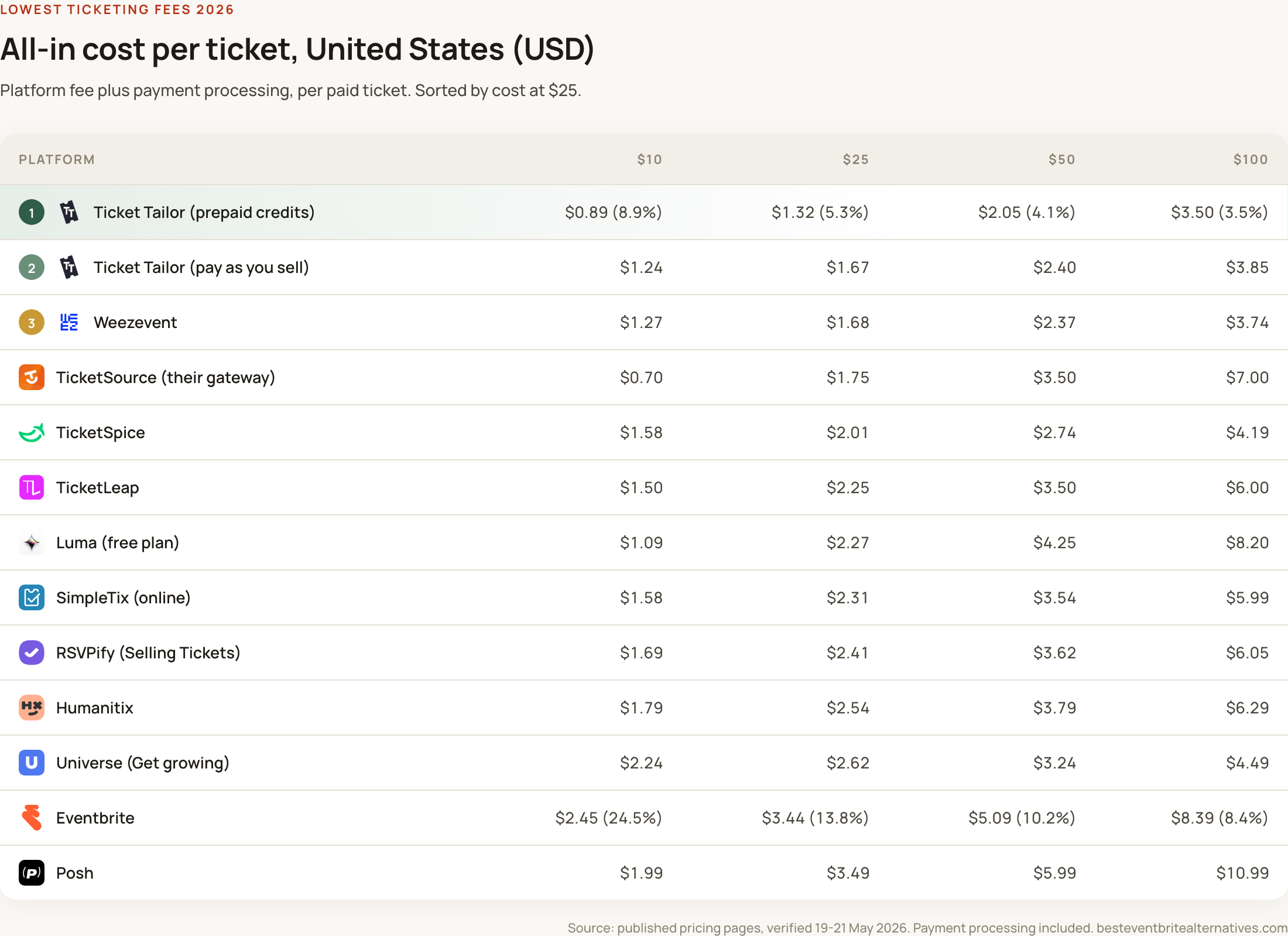
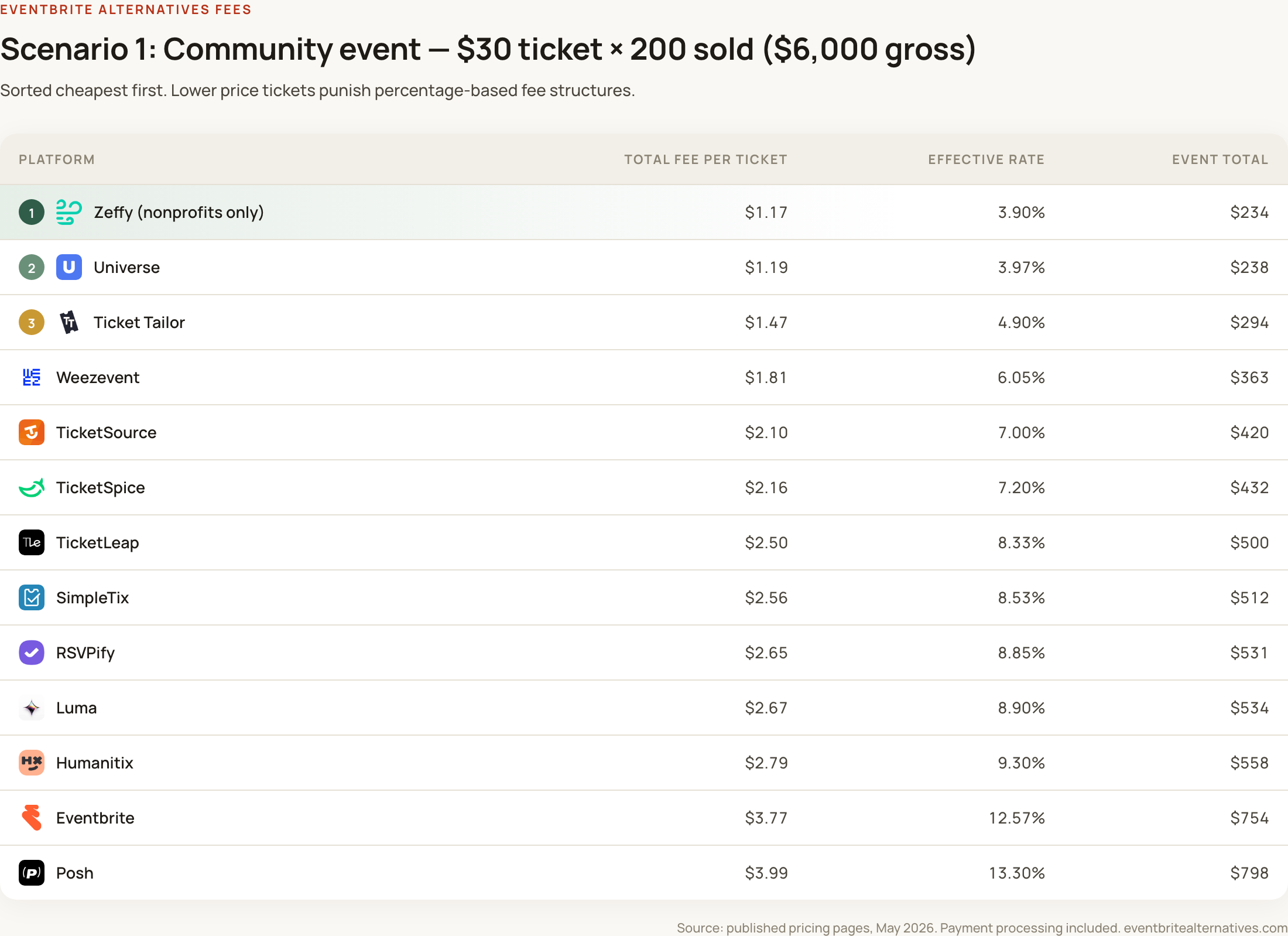
    It depends on your ticket price. For mid-to-high-value tickets (£20+ / $25+), flat-fee platforms like Ticket Tailor are typically cheapest: you pay around £0.60 / $0.65 per ticket regardless of price, plus Stripe processing. For very low-priced tickets, percentage-based platforms (Universe, Humanitix) can be competitive. Zeffy is free if you're a registered US or Canadian nonprofit. Use the calculator above to see exact figures for your event.
  • Why are Eventbrite's fees so high?

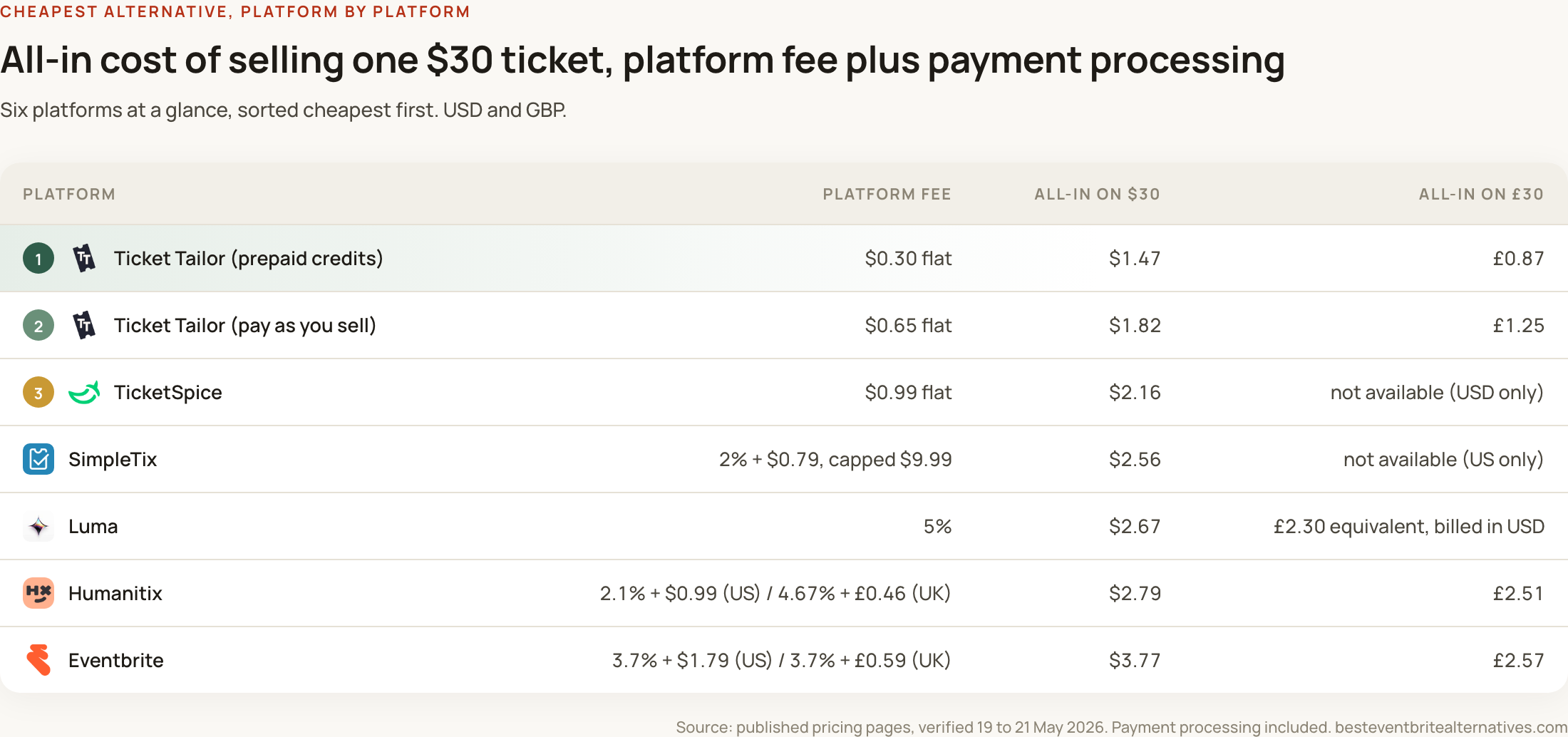
    Eventbrite charges 3.7% + $1.79 per paid ticket (or 3.7% + £0.59 in the UK) plus 2.9% payment processing, a flat-fee-plus-percentage model. The percentage component means fees scale with ticket price: a $50 ticket costs you about $5.06 in fees, but a $200 ticket costs around $15.55. Most alternatives charge significantly less, particularly once tickets cross $20.
  • Do I have to pass ticketing fees on to my attendees?

    No. Almost every ticketing platform lets you choose: either absorb fees into the ticket price you set (attendee pays the headline price, you net less), or pass them through (attendee pays your price plus fees at checkout, you net the full ticket price). Posh is the main exception: they require all-in pricing where fees are baked into the displayed price. The choice affects your bottom line but not your obligations.
  • Are there any genuinely free ticketing platforms?

    For paid events: Zeffy is genuinely free for registered US and Canadian nonprofits, funded entirely by optional donor tips. For free events: most platforms (including Eventbrite, Ticket Tailor, Humanitix, TicketSource, Luma, Weezevent and Universe) charge no fees at all. The notable exception is TicketSpice, which still charges $0.99/ticket even on free events unless paired with paid ones.
  • What hidden ticketing fees should I watch out for?

    Three common ones to scrutinise. (1) Monthly subscriptions: most platforms have none, but RSVPify and See Tickets lean subscription-based with tiered monthly fees. (2) Add-on costs: email marketing, SMS reminders, advanced seating charts and custom domains can carry extra monthly fees. Luma is the standout: while their headline fee looks cheap, they charge $50 to $800/month for newsletter sends above 500/week. (3) Payment processing: usually around 2.9% + $0.30, sometimes bundled into the headline platform fee (TicketSource, Weezevent, Universe, Posh).
  • How do payment processing fees work?

    Payment processing is the card-handling fee charged by the payment gateway, typically Stripe, Square, PayPal or the platform's own processor. Standard rates are about 2.9% + $0.30 per transaction in the US, or 1.5% + £0.20 in the UK. Some platforms bundle processing into their headline platform fee (TicketSource's 7%, Weezevent's 2.5% + £0.99, Universe's 2% + £0.99). Others charge it separately on top, which is what the calculator breakdown shows as a distinct line item.

Pricing analysis: read more

Go deeper than the headline rate. Worked examples, hidden-fee categories, and the maths behind which model wins for your ticket price.

View all →