Ticketing for concerts and music festivals: choosing a platform in 2026
How to pick a ticketing platform for club shows, tours and festivals, with verified US and UK fees, the features that actually matter on a music night, and what to ask before you commit.
Music has the tightest margins of any event category and some of the most demanding ticketing requirements. A 250-capacity club show at £20 turns over £5,000 gross, and the difference between a good platform and a bad one is somewhere between £180 and £560 of that. Across a 20-date tour, that’s the guarantee for another show.
This page covers what to look for, what the realistic options cost in both currencies, and where the specialist platforms earn their premium.
What a music platform has to do that a generic one doesn’t
Get you paid before the show, not after. Tours run on cash flow. Vans, hotels, backline hire and venue deposits are due before a single ticket is scanned. Platforms that connect to your own Stripe, PayPal or Square account - Ticket Tailor, SimpleTix, TicketSpice, TicketSource via Stripe - put ticket money in your bank as it sells. Platforms using their own gateway pay out on their schedule, which for a touring artist is a genuine operational problem, not a preference.
Handle a rush. On-sale moments concentrate months of traffic into ninety seconds. Ask any vendor directly what their on-sale handling looks like: queuing, rate limiting, and whether there’s a waiting room. This is the area where marketing pages are vaguest and where you should demand specifics rather than trust a comparison table, including ours.
Scan fast at the door with no signal. A basement venue with no reception is the normal case, not the edge case. Offline-capable scanning that syncs on reconnect is essential. Ticket Tailor, Weezevent, TicketSpice, SimpleTix, Humanitix and TicketLeap all ship check-in apps for iOS and Android; confirm offline mode with the vendor for your specific setup.
Do tiers properly. Early bird, advance, on the door, VIP, guest list. Anything that can’t hold several ticket types with capacity limits and timed price changes will cost you money in lost early-bird momentum.
Sell merch in the same checkout. Adding a shirt or a vinyl pre-order to the ticket transaction is the cheapest revenue in live music. Ticket Tailor, TicketSpice, Weezevent, Humanitix and Eventcube all support add-on products.
Give fans a legitimate resale route. Sold-out shows create scalping unless there’s a sanctioned face-value option. Ticket Tailor added a Tixel resale integration in the US in January 2026; several platforms support transfers. If your shows sell out, ask about this specifically.
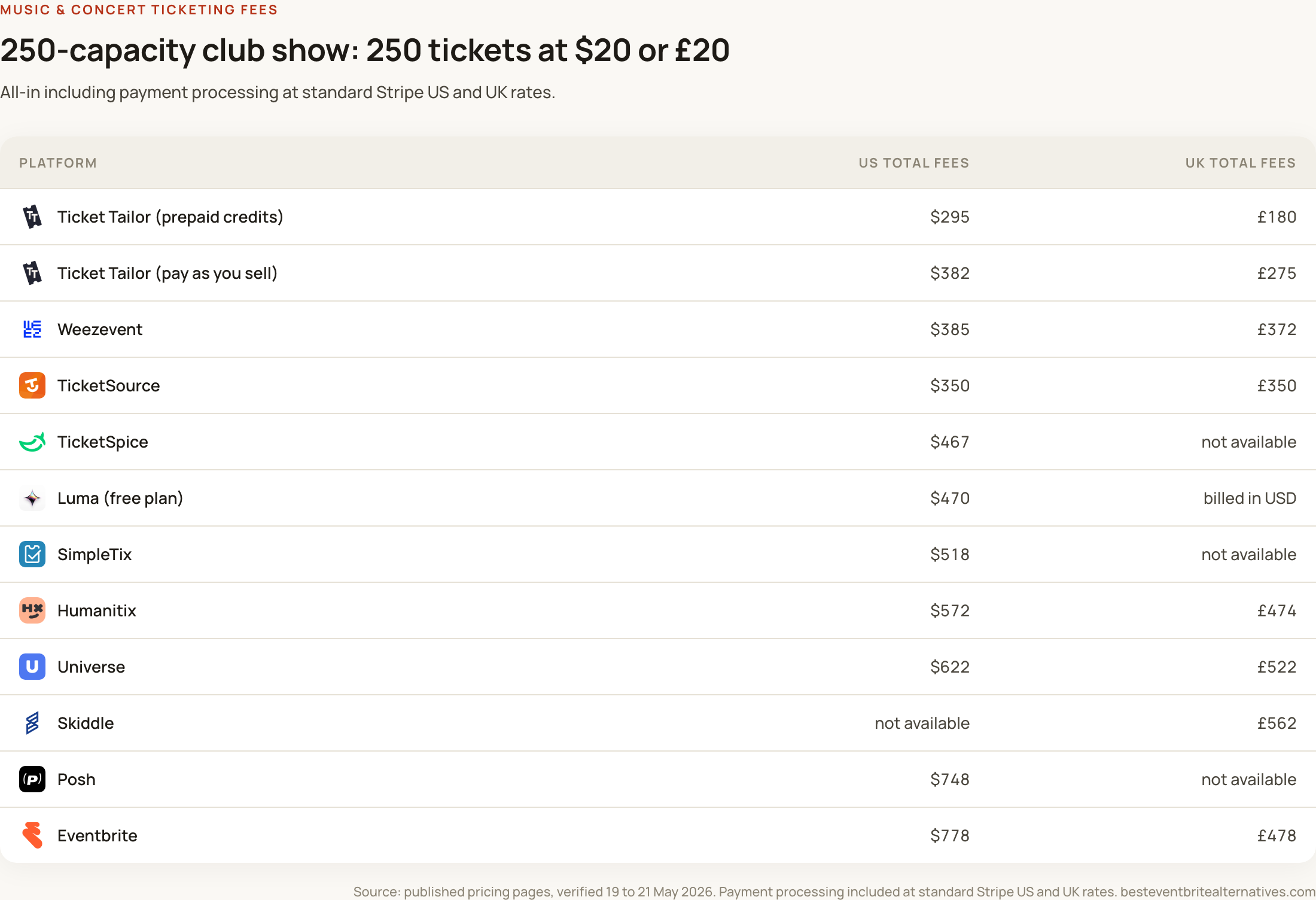
What it costs: a 250-capacity club show
250 tickets at $20 or £20, all-in including payment processing:
And an 800-capacity show at $45 / £45
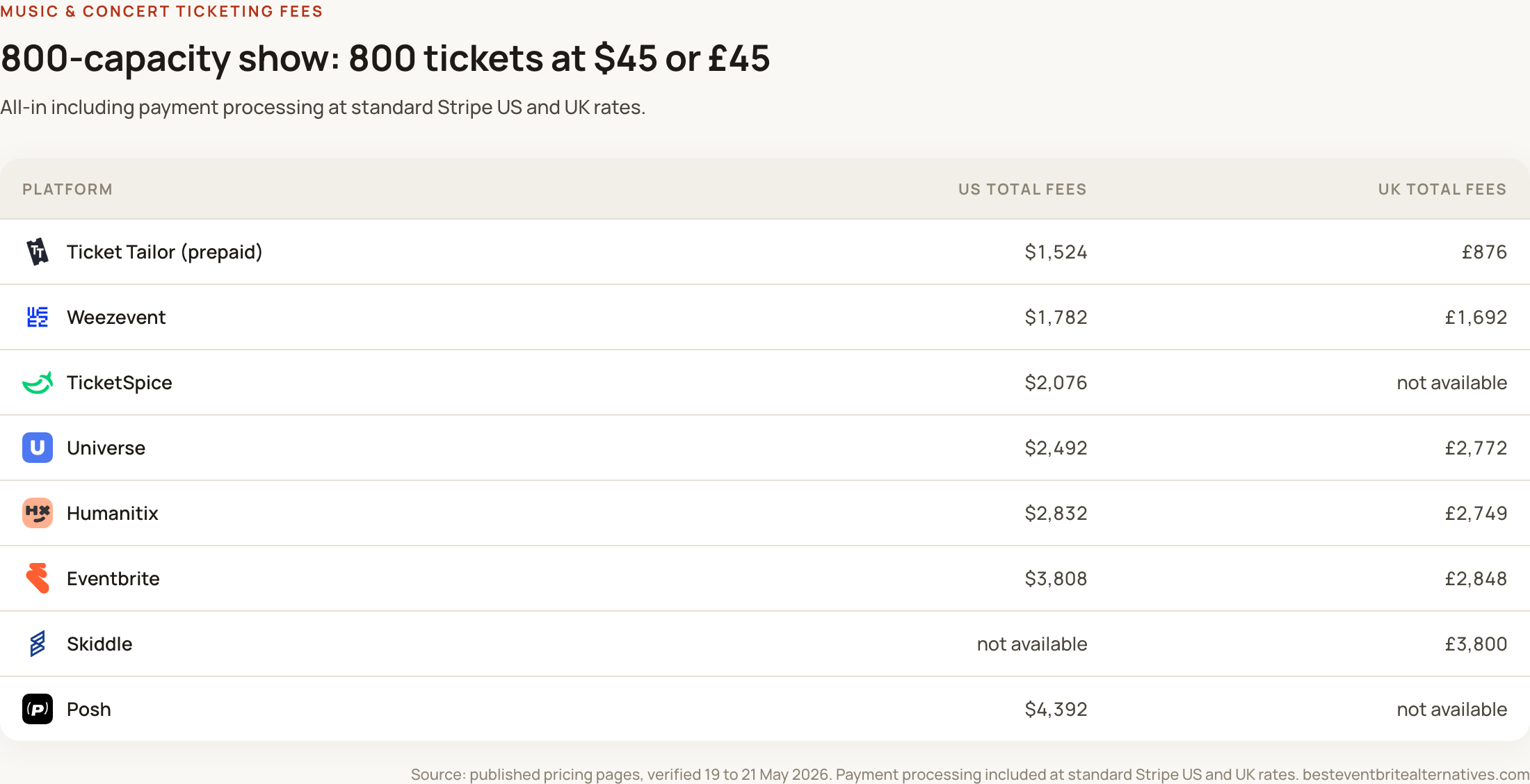
At festival scale the numbers stop being marginal. 1,000 tickets at £75: Ticket Tailor £1,545, Weezevent £2,865, Universe £5,115, Eventbrite £5,540, Skiddle £7,750.
UK figures use Stripe UK card rates (1.5% + £0.20), which are roughly half US rates and are why the sterling columns look so much lower. UK platform fees are quoted excluding VAT where the platform quotes them that way.
The realistic options
Ticket Tailor - default choice for independent music
$0.30 per ticket on prepaid credits, $0.65 pay as you sell; £0.22 or £0.60 + VAT. Flat fee means a £45 ticket costs the same to sell as a £12 one, which is the right shape for music where prices vary by night and city. Your own Stripe, PayPal or Square account holds the money, so you’re paid during the on-sale rather than after the show. Free events are free up to 5,000 tickets a year - useful for launch parties and industry showcases.
Practical fit: multiple ticket types with timed price tiers, offline check-in app, embeddable checkout so tickets sell from your own site rather than a third party’s, discount codes for radio and support-act promos, referral tracking, Meta and TikTok pixels for retargeting, white-label custom domains, and Tixel resale in the US.
Limits for music: no discovery marketplace, so this suits acts and promoters with their own audience. Seating charts are charged via credits, so seated venues should model it. Not built for stadium-scale accreditation.
Weezevent - festivals with a bar and a site
2.5% + £0.99 UK, 2.75% + $0.99 elsewhere, processing included. The reason to choose it is everything that happens after the ticket sells: RFID cashless wristbands and smart cups, mobile payment terminals, NFC access control, staff accreditation, and 2D/3D seating with virtual queuing. If you’re running bars across a multi-stage site, cashless typically pays for itself in throughput and shrinkage before you consider the ticket fee at all.
Skiddle - UK club nights and gigs with discovery
10% + £0.25 with a £1 minimum booking fee, processing bundled. That’s the most expensive per-ticket option in the UK table, and the £1 minimum means anything under about £7.50 pays £1 flat. What you’re buying is audience: Skiddle is where a lot of UK clubbers actually browse. The sensible pattern is to treat it as a paid discovery channel alongside a cheaper primary platform, and to check whether the listings are selling tickets your own channels wouldn’t have.
Posh - US nightlife
10% + $0.99, all-in pricing so the buyer sees a single number. Native consumer app with a discovery feed built for club nights, parties and social experiences, plus promoter tools, affiliate links and group buys. Same logic as Skiddle: you’re paying for the feed, so measure whether the feed delivers.
Universe - if you want Ticketmaster distribution
2.5% + $1.99 US capped at $19.95, 5.5% + £0.99 UK capped at £9.95, processing bundled. Positioned at music and nightlife, and its Pro tier can distribute through Ticketmaster, which nothing else independent here offers. Ticketmaster ownership is a reason some independent promoters rule it out on principle; that’s a judgement call, not a spec.
SimpleTix or TicketLeap - seated venues
If you’re programming a seated theatre or listening room rather than a standing venue, both have strong seat-map builders. SimpleTix ($0.79 + 2%, capped at $9.99, US only) has the deeper implementation with hold management for comps and accessibility. TicketLeap ($1.00 + 2%, capped at $20, plus 3% per order) has best-seat logic and a mobile-first buyer flow.
Eventbrite - only if discovery is genuinely working
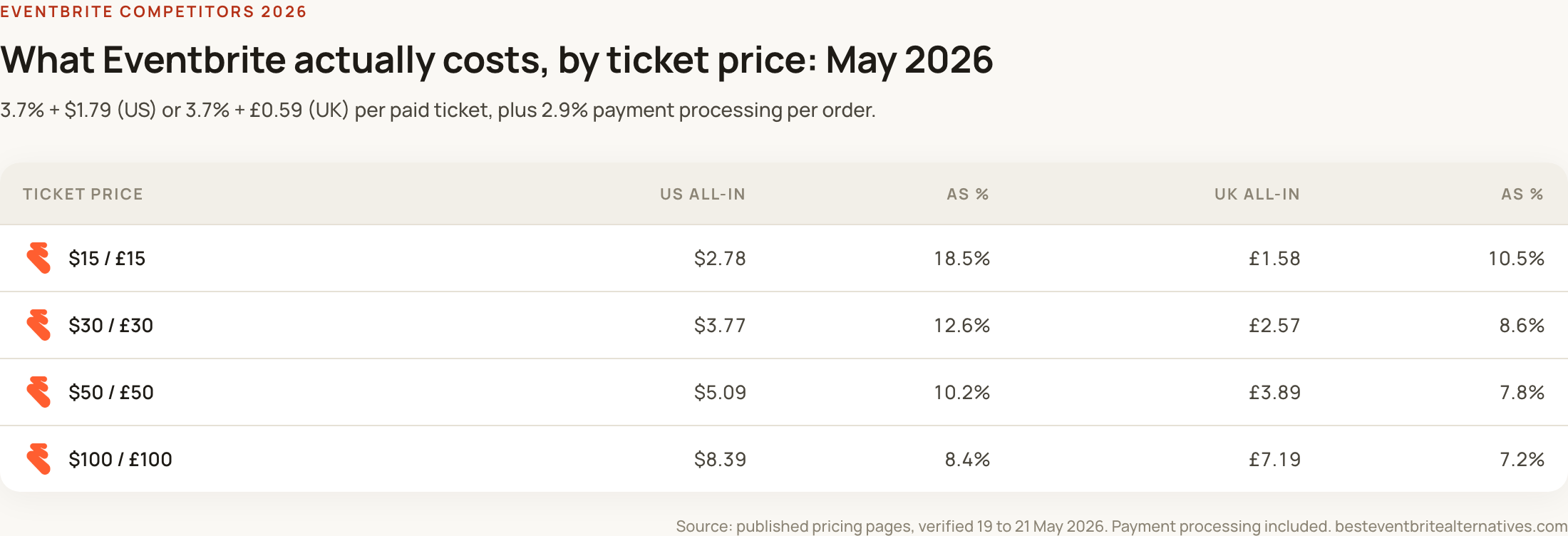
$3.77 all-in on a $30 ticket, £2.57 on £30. The marketplace is the largest in the category. Check your own source reports: if Eventbrite’s search and recommendations aren’t a meaningful share of your buyers, you’re paying discovery rates for your own Instagram traffic.
Budget notes specific to music
- Decide early whether fees are absorbed or passed on. Most platforms let you absorb, pass on, or split. In UK grassroots music, an advertised price that matches what’s charged at the door tends to convert better; in the US, buyers are accustomed to fees at checkout. Posh has no choice in the matter - US all-in pricing rules mean fees are baked into the displayed price.
- Flat fees suit variable pricing. If your ticket prices range from £8 support-band nights to £45 headline shows, a flat per-ticket fee gives you one predictable cost line rather than one that scales with your best nights.
- Model your cheap nights, not your average. On a £10 ticket, percentage-plus-processing structures take a much larger share than the headline suggests. That’s where a flat fee earns most.
- Watch minimums and caps. Skiddle’s £1 minimum hurts cheap tickets; SimpleTix’s $9.99 cap and Universe’s caps help expensive ones.
- Count the extras. Email sends, SMS, custom domains, seat maps and cashless hardware are billed separately on several platforms.
Questions to ask a vendor before you commit
- 1. When exactly does money reach my bank - as tickets sell, or after the event?
- 2. What happens to my on-sale if 3,000 people arrive in the first minute?
- 3. Does the scanning app work with no internet, and how does it reconcile afterwards?
- 4. Can I set timed price tiers and hard capacity limits per ticket type?
- 5. Can fans transfer or resell at face value, and can I set a cutoff?
- 6. Can I sell merch and add-ons in the same checkout, and at what fee?
- 7. What is the fee on a £10 ticket and on a £60 ticket, including processing and VAT?
- 8. Can I export my attendee data, and does it sync to my mailing list?
Frequently asked questions
What’s the cheapest platform for a club show?
Ticket Tailor on prepaid credits: roughly $295 in fees on a 250-capacity $20 show in the US, or £180 on the UK equivalent, against $778 and £478 on Eventbrite.
Should I use a platform with a marketplace, like Skiddle or Posh?
Only if you can see it working. Run a show on both, tag your own links, and compare. Discovery platforms cost roughly two to three times a flat-fee platform per ticket, which is a fair price if they genuinely fill the room and an expensive one if they don’t.
How do I get paid before the show?
Choose a platform that connects to your own Stripe, PayPal or Square account rather than paying out from its own float. Ticket Tailor, SimpleTix, TicketSpice and TicketSource’s Stripe route all work this way.
Do I need reserved seating?
Only for seated venues where sight lines vary. Standing rooms and festival fields are better served by general admission with tiered pricing, which is cheaper to run and faster at the door.
What about scalping?
Ask about transfer controls, purchase limits per buyer and a sanctioned face-value resale route. Ticket Tailor’s Tixel integration launched in the US in January 2026; other platforms handle transfers to varying degrees. Treat vague marketing claims about “anti-bot protection” with scepticism and ask what it does specifically.
Are these figures current?
Platform pricing verified 19 to 21 May 2026 against published pricing pages, with payment processing modelled at standard Stripe US and UK rates. Check before committing a large on-sale.