The cheapest alternative to Ticket Tailor, Humanitix, TicketSpice, SimpleTix, Eventbrite and Luma (2026)
Six platforms, six honest answers. What each one actually costs in USD and GBP, what genuinely undercuts it, and when the cheaper option is the wrong choice.
Search for “cheapest alternative to X” and you’ll find a dozen articles that give the same answer for all six platforms, usually a platform the writer happens to be paid to recommend. That’s not a comparison, it’s a coincidence.
Here’s the version with the working shown. Six platforms, current published pricing in both USD and GBP, and a straight answer for each - including one case where the honest answer is “nothing meaningfully cheaper exists” and another where “cheaper” would cost you the feature you’re paying for.
All six at a glance
All-in cost of selling one $30 ticket, platform fee plus payment processing:
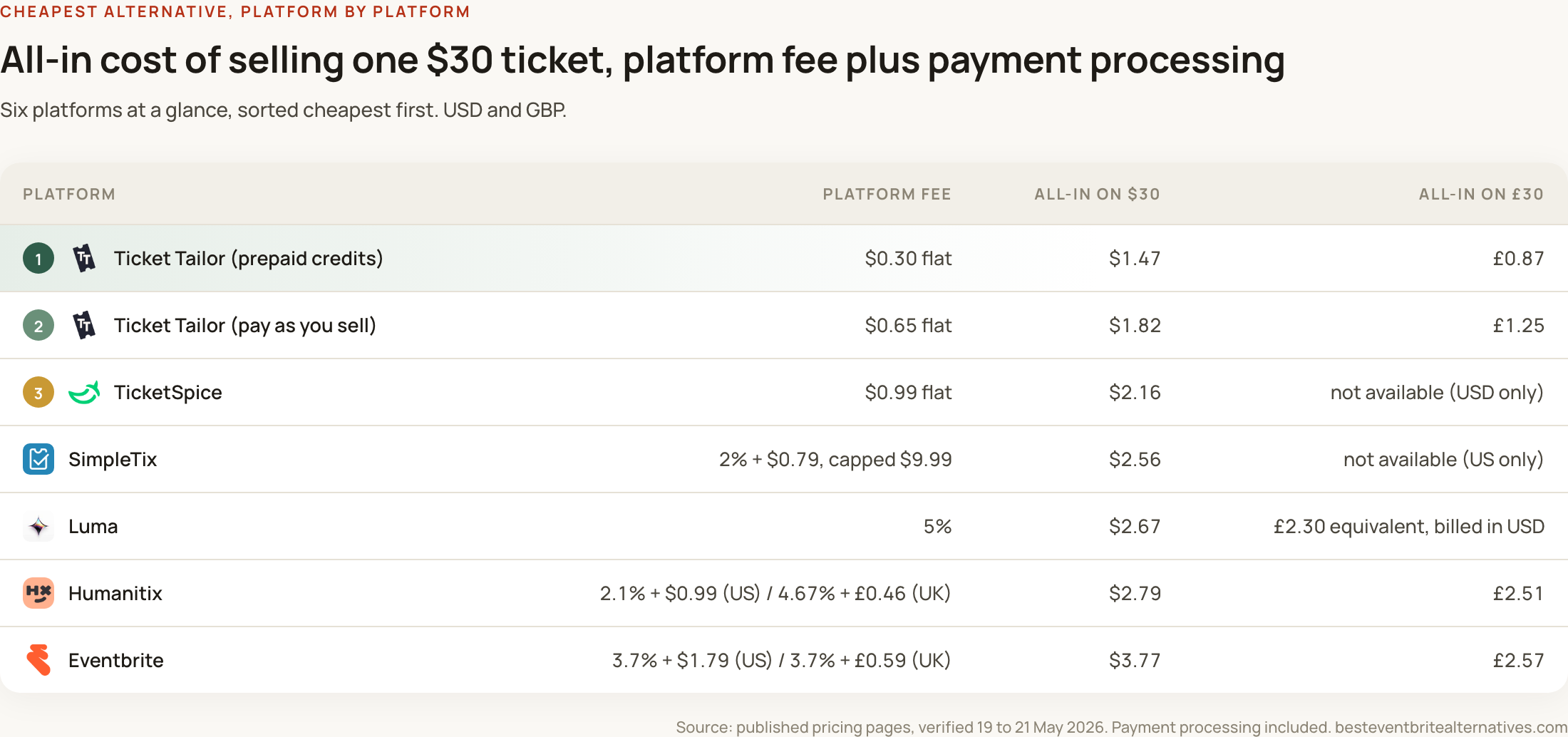
Processing modelled at Stripe US 2.9% + $0.30, or Stripe UK 1.5% + £0.20. UK platform fees quoted excluding VAT where the platform quotes them that way.
1. The cheapest alternative to Ticket Tailor
The honest answer: for most organisers, there isn’t one.
That’s an unsatisfying result for an article like this, but the arithmetic is the arithmetic. At $0.30 per ticket on prepaid credits, or £0.22 + VAT in the UK, Ticket Tailor’s flat fee is the lowest published rate among the platforms we track, and it doesn’t rise with your ticket price. Registered charities get 50% off, schools and PTAs 20%, and free events are free up to 5,000 tickets a year.
There are three real exceptions:
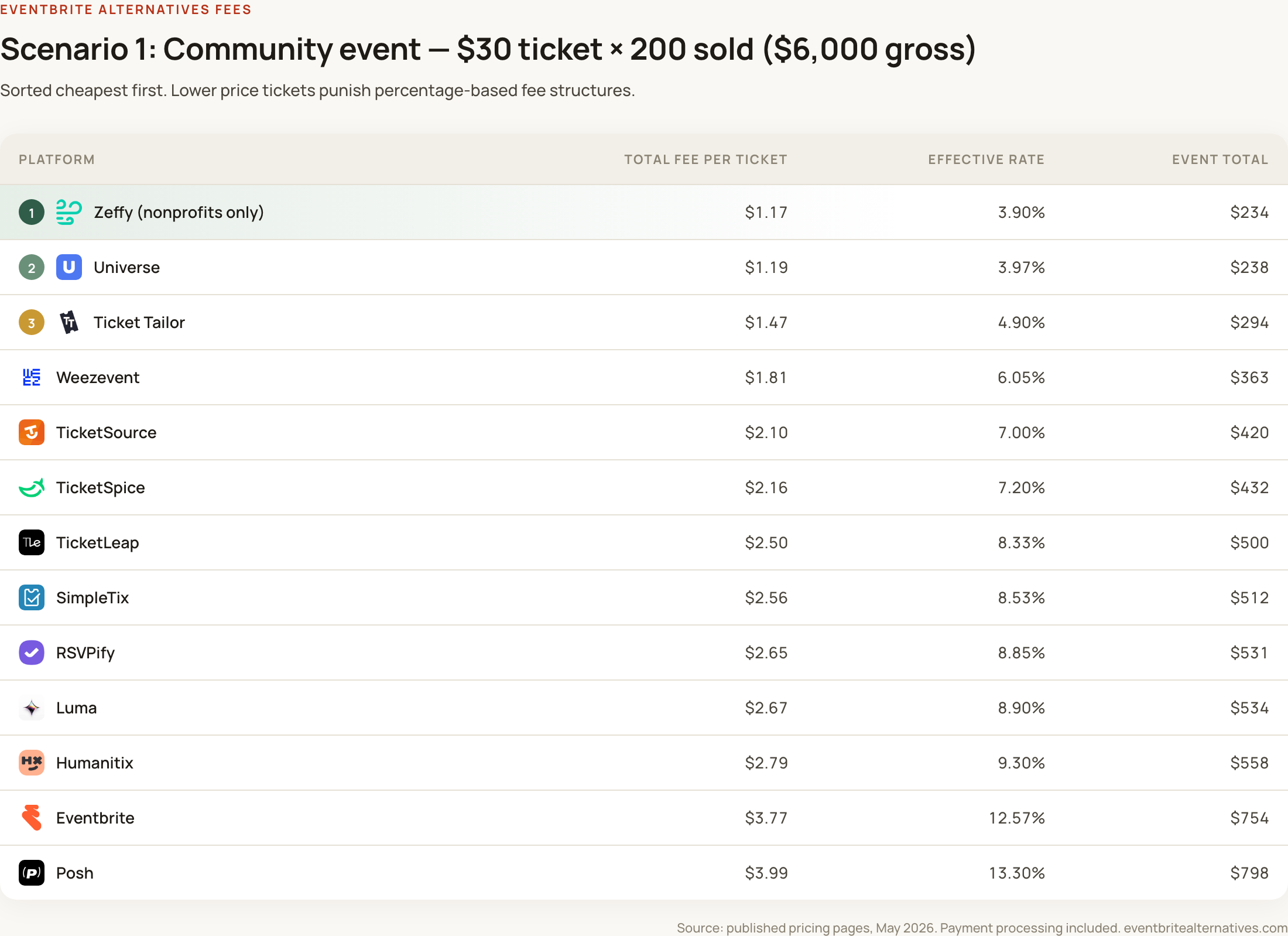
Zeffy, if you’re a registered US or Canadian nonprofit. It’s $0. No platform fee, no processing fee. Zeffy is funded by an optional contribution suggested to your buyers at checkout, which some organisations find awkward and some don’t. If you qualify, nothing on this page competes.
TicketSource, if your tickets are very cheap. TicketSource’s 7% bundles card processing into a single rate. On a $10 or £10 ticket that’s £0.70 versus Ticket Tailor’s £0.57 - so Ticket Tailor still wins - but the gap is pennies, and TicketSource throws in staff-operated phone bookings, which nobody else here does. Above about £20 the percentage overtakes the flat fee decisively: on a £100 ticket TicketSource costs £7.00 against £1.92.
Weezevent, if you need RFID cashless. More expensive per ticket (£1.74 on a £30 ticket), but if you’re running wristband payments and access control across a festival site, per-ticket fee isn’t the deciding number.
What you give up by staying: no discovery marketplace, and no native email marketing platform - Ticket Tailor integrates with Mailchimp, HubSpot and ActiveCampaign rather than replacing them.
2. The cheapest alternative to Humanitix
What Humanitix costs: 2.1% + $0.99 in the US, 4.67% + £0.46 excluding VAT in the UK, plus Stripe processing. That’s $2.79 all-in on a $30 ticket, £2.51 on a £30 one.
The cheapest alternative: Ticket Tailor, at $1.47 / £0.87 on the same ticket. On 500 tickets at $40, that’s roughly $700 saved.
But read this before switching. Humanitix is a not-for-profit that donates its booking fee profits to children’s education programmes. You are not paying more for worse software - you’re paying more because the margin goes somewhere. Charities and schools also get a discounted rate: 1% + $0.99 in the US, 3.33% + £0.25 in the UK.
The reframe worth considering: if you switch to a flat-fee platform and donate the difference to a cause you’ve chosen, more money reaches the cause, because you’re donating the full saving rather than a platform’s profit margin on the fee. Whether that’s better depends on whether the charitable framing is itself part of how you market the event. For a fundraising gala where “our ticket fees fund education” appears on the invitation, it probably is.
3. The cheapest alternative to TicketSpice
What TicketSpice costs: $0.99 flat per ticket, dropping to $0.49 for tickets under $5 and for box office sales, plus your own merchant processing. USD only. Note that email marketing ($9/month plus $0.02 per recipient), SMS ($19/month), and a custom domain ($150/year) are separate, and using a third-party processor adds 1%.
The cheapest alternative: Ticket Tailor at $0.30 prepaid - $1.47 all-in against TicketSpice’s $2.16 on a $30 ticket. Over 2,000 tickets that’s around $1,380.
But read this before switching. TicketSpice’s RealView builder with 40+ field types and conditional logic is a genuinely different product from a standard event page. If your registration flow branches - different questions for exhibitors versus attendees, dynamic pricing based on answers, complex waivers - you’re not paying for ticketing, you’re paying for a form engine, and the flat-fee platforms won’t replace it.
One more thing worth knowing: if you run only free events, TicketSpice still charges $0.99 per ticket unless you also sell paid tickets on the platform. Every other platform in this article handles free tickets for free. That single detail makes it the wrong choice for free-event organisers regardless of price.
4. The cheapest alternative to SimpleTix
What SimpleTix costs: $0.79 + 2% per online ticket, capped at $9.99, plus your own processing. In-person box office sales are $0.25. Verified 501(c)(3) nonprofits pay $0.71 + 2%. US only.
The cheapest alternative: Ticket Tailor at $1.47 versus $2.56 on a $30 ticket. On 400 tickets at $60 that’s roughly $500.
But read this before switching. SimpleTix has the strongest reserved-seating implementation among the low-cost platforms - free seat-map builder, in-order seat changes, hold management, and timed entry designed for attractions and museums. It also pays out immediately to your own merchant account and integrates natively with Square, which matters if you’re already running Square hardware at the door.
Ticket Tailor does have a seating chart designer, but seats are charged via credits, so the saving narrows for seated events. If you’re a theatre selling assigned seats every week, model both properly rather than trusting the flat-fee headline.
Also note the fee cap. On a $500 gala seat, SimpleTix charges $9.99 where a percentage platform would charge $20 or more. High-value seated events are exactly where SimpleTix’s pricing is competitive.
5. The cheapest alternative to Eventbrite
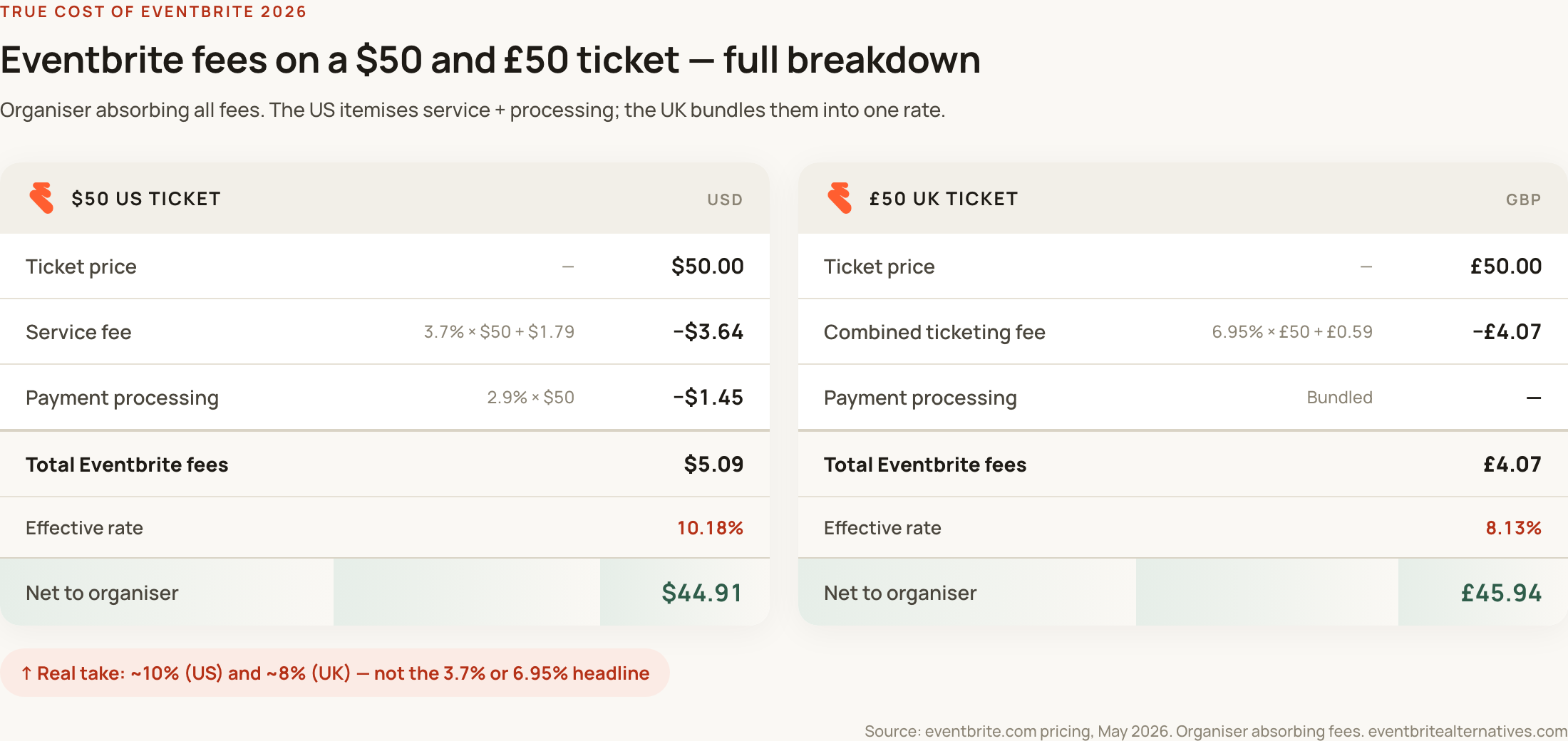
What Eventbrite costs: 3.7% + $1.79 per ticket in the US, 3.7% + £0.59 in the UK, plus 2.9% payment processing charged per order. That’s $3.77 on a $30 ticket, 12.6% of face value. On a $15 ticket it’s 18.5%.
The cheapest alternative: Ticket Tailor, at $1.47. On 200 tickets at $30 the difference is $460; on 1,000 tickets at £75 it’s around £4,000.
But read this before switching. Eventbrite’s marketplace is the largest in the category and it’s the only thing here you genuinely cannot replicate yourself. The question is whether it’s working for you. Check your own Eventbrite sales report: how many buyers came from Eventbrite’s own search and recommendations, versus from your email list, your Instagram, and your website? If it’s mostly the latter, you’re paying marketplace rates for traffic you generated.
A common correction to a claim you’ll see repeated: Eventbrite’s UK rate is 3.7% + £0.59, not “6.95%” or “nearly double the US”. In absolute terms the UK fixed fee is lower than the US one.
6. The cheapest alternative to Luma
What Luma costs: 5% on paid tickets on the free plan, plus Stripe. Luma Plus at $59/month billed annually removes the platform cut. Free events are free on every plan.
The buried cost nobody mentions: newsletter sends are metered. The free plan includes 500 sends a week. Luma Plus includes 5,000. Above that it’s $50 to $800 a month depending on volume. If you have a 20,000-person list and email it about each event, Luma stops being the cheap option and becomes one of the most expensive on this page. Most ticketing platforms include attendee email at no extra charge.
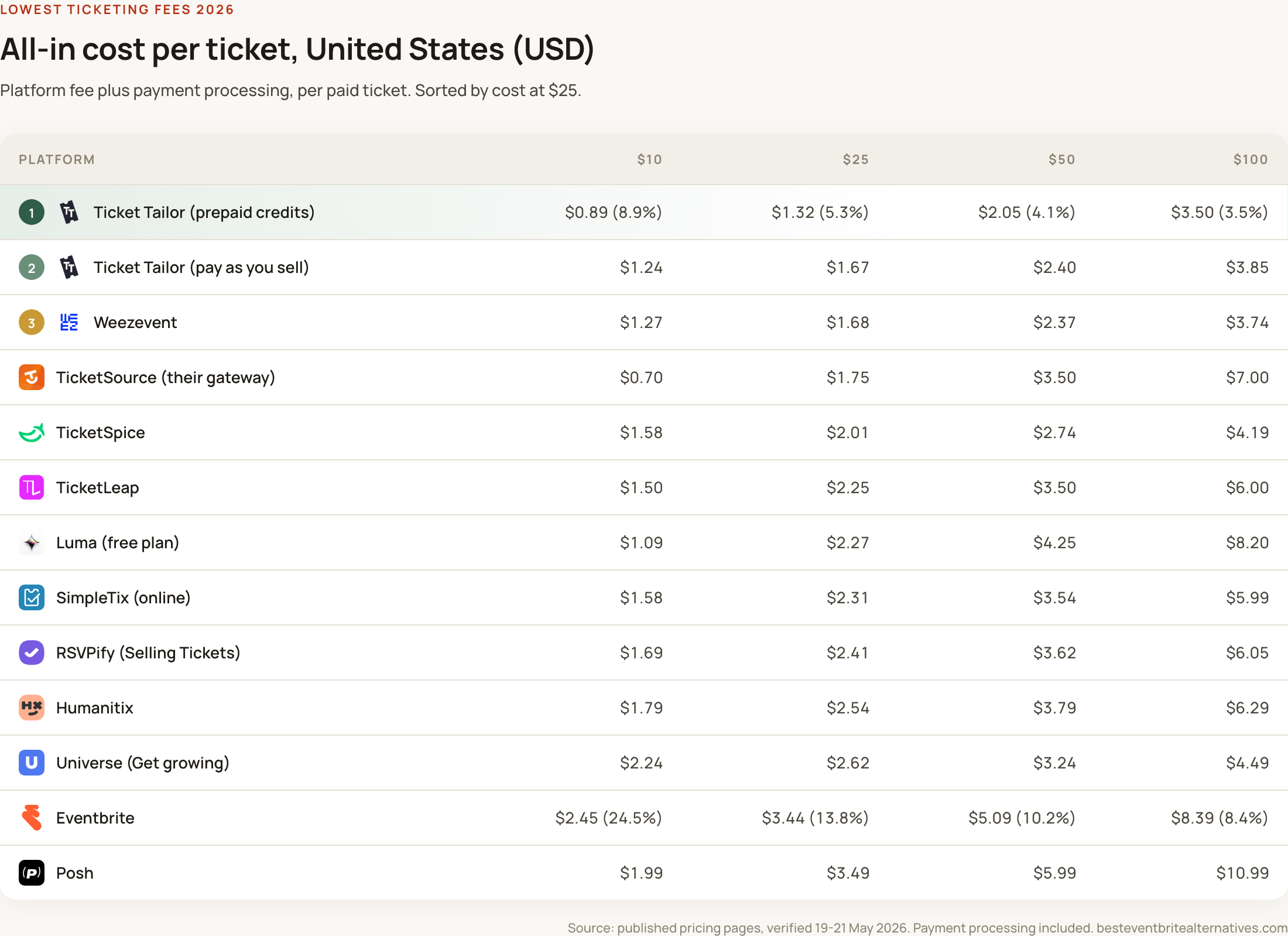
The cheapest alternative: Ticket Tailor at $1.47 versus Luma’s $2.67 on a $30 ticket, and $3.50 versus $8.20 on a $100 one - because Luma’s 5% is uncapped and a flat fee isn’t.
But read this before switching. Luma’s event pages are the best-looking in the category, and its calendar-first model is a real product advantage for recurring communities: subscribers follow your calendar and get every event automatically. If you run a weekly meetup that is genuinely free, Luma’s free tier is excellent and switching gains you nothing.
The common pattern is to do both - keep a Luma calendar for community and discovery, and sell paid tickets through a flat-fee platform.
Side by side, across every ticket price
All-in cost per ticket, USD:
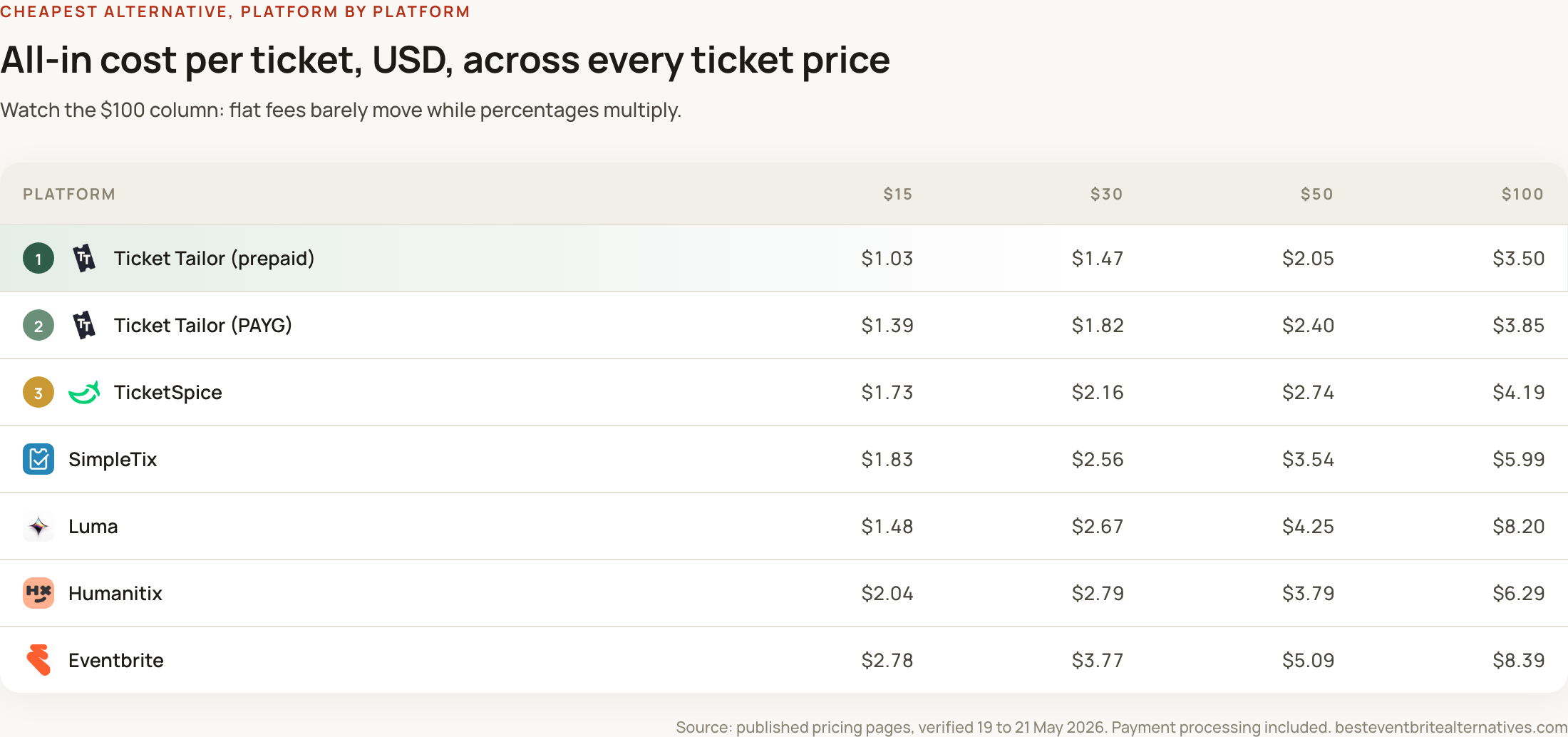
Watch the $100 column. The two flat-fee rows have barely moved while Luma has more than quintupled and Eventbrite has tripled. That is the entire argument for flat pricing in one line.
A real event: 250 tickets at $20
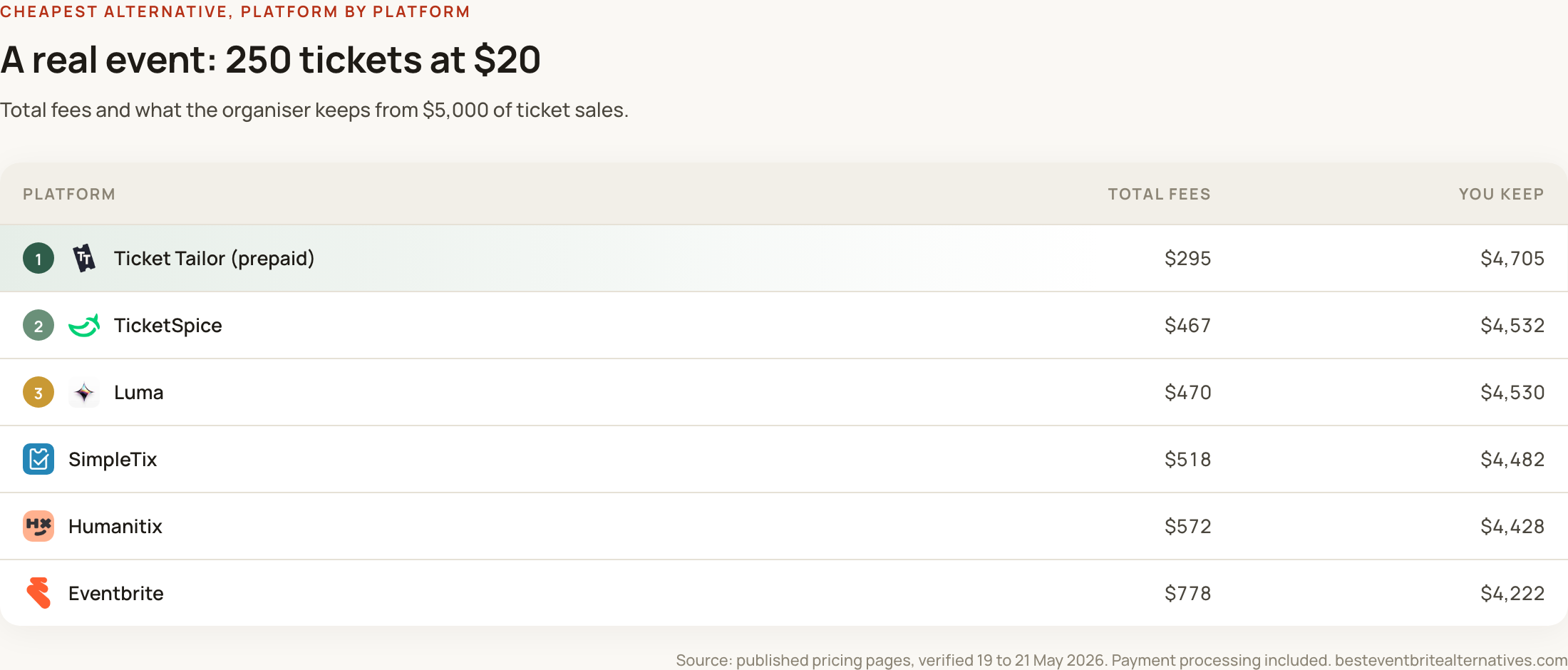
The same show in the UK at £20, where cheaper card processing widens the gap: Ticket Tailor £180, Humanitix £474, Eventbrite £478.
Where each platform is still the right answer
- Stay on Luma if your events are free and design and community discovery are the point.
- Stay on Humanitix if the charitable model is part of your event’s identity, or you qualify for the charity and school rate.
- Stay on SimpleTix if you sell assigned seats, run timed entry, or live inside Square.
- Stay on TicketSpice if your registration form has real conditional logic in it.
- Stay on Eventbrite if you can show, from your own reports, that its marketplace is selling tickets you couldn’t.
- Stay on Ticket Tailor if per-ticket cost is what you’re optimising for. It’s already the cheapest option here.
Frequently asked questions
What is the single cheapest of these six?
Ticket Tailor, at $0.30 per ticket on prepaid credits in the US and £0.22 + VAT in the UK, plus your own payment processing.
Is a flat fee always cheaper than a percentage?
No. Below roughly £5 to £10 a ticket, a bundled percentage that includes card processing can win, because the fixed processing charge dominates. Above that, flat fees pull away and keep pulling away.
Do I have to migrate tickets already sold?
No. Run the current event to completion on your existing platform and launch the next one elsewhere. If you’re already using your own Stripe account, payouts continue to the same bank.
Can I pass fees to attendees?
Yes on all six. You can absorb, pass on, or split.
How current is this?
Pricing verified 19 to 21 May 2026 against each platform’s published pricing page. Ticketing fees change frequently, so check before committing a large event.