The true cost of Eventbrite in 2026
Line-by-line Eventbrite fees on a $50 / £50 ticket, the effective rate at four price points, and the small-print charges most organisers underestimate.
If you asked an Eventbrite organiser what the platform charges them, most would quote either the headline percentage or whatever rate they last saw at checkout. Neither answer is quite right. Eventbrite’s fees are clearly published, but the figure most organisers carry in their heads underestimates what the platform actually takes by a meaningful margin. This piece walks through every line item on a paid Eventbrite event in 2026, shows the maths on a representative $50 / £50 ticket, and works the same calculation across four price points so any organiser can find themselves on the scale.
Free events on Eventbrite remain free, which is a genuine and underappreciated feature of the platform. Everything that follows applies only to paid events.
The fee anatomy
Eventbrite’s pricing splits into two structures depending on region. Both are published on the company’s pricing page; both compound in ways the page itself does not show.
In the United States, Eventbrite charges two separate fees on every paid ticket. The first is a service fee of 3.7% of the ticket price plus $1.79 per ticket. The second is a payment processing fee of 2.9% applied to the order total. The two fees stack. On a $50 ticket, the service fee is $3.64 and processing is $1.45, for a combined $5.09. That works out to 10.18% of the ticket price.
In the United Kingdom, Eventbrite uses a single bundled rate of 6.95% plus £0.59 per ticket, with payment processing folded into the headline number. On a £50 ticket, the combined fee is £4.07, or 8.13%. The UK structure is simpler to read but not necessarily cheaper. The rate is more competitive on lower-priced tickets and less so on higher-priced ones, because the bundled percentage runs ahead of the US equivalent once volume scales.
Both structures share a feature that pricing pages tend not to highlight: the effective rate is variable, not fixed. A 3.7% service fee plus a $1.79 fixed component lands very differently on a $15 ticket than on a $150 ticket. The percentage scales, the fixed amount does not, and the proportion you actually pay shifts with every price point.
What you keep on a $50 / £50 ticket
Take a $50 ticket in the United States, sold through Eventbrite, with the organiser absorbing all fees (the more demanding case for the organiser, and the cleaner one for analysis). The equivalent calculation in the United Kingdom uses the bundled UK rate.
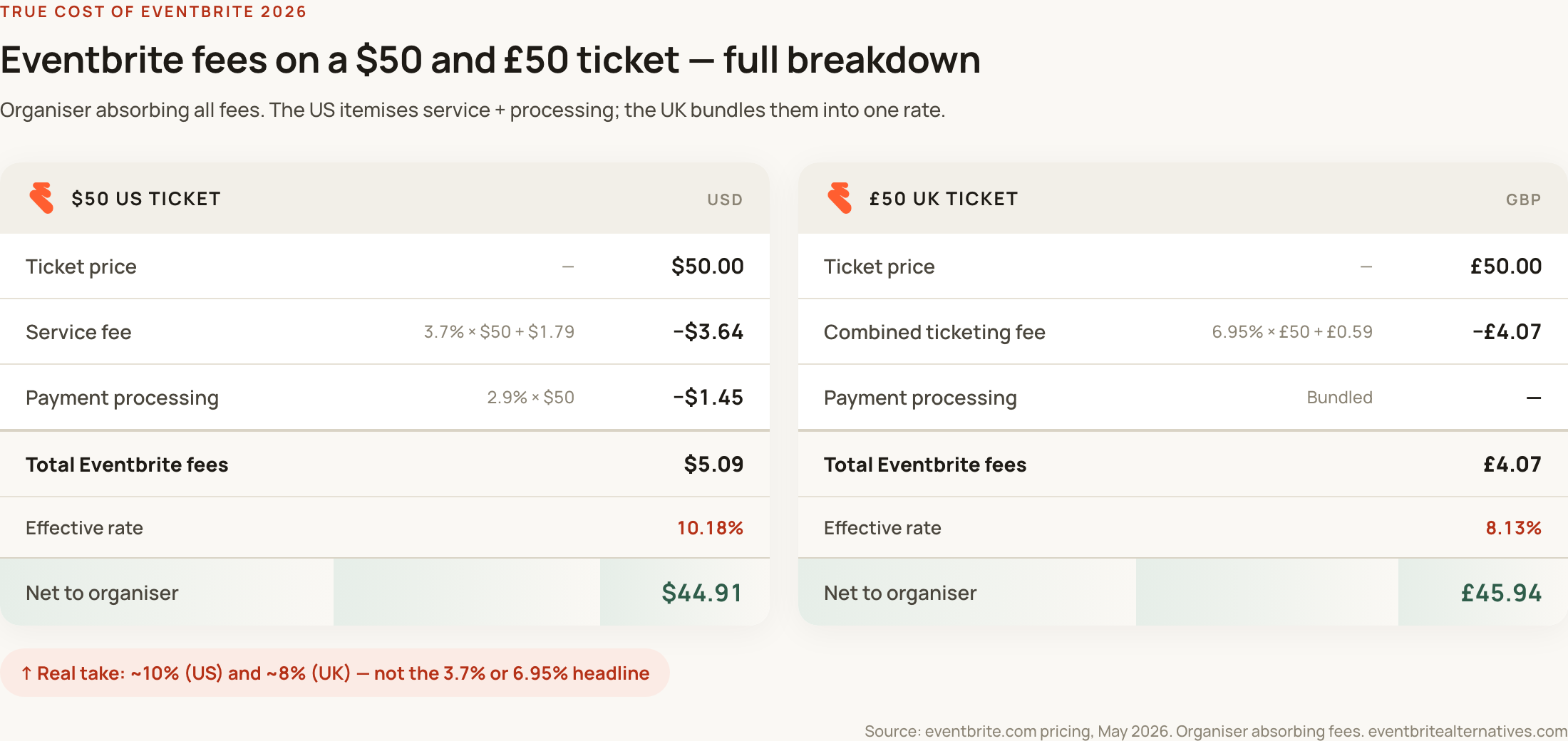
This is the headline answer. On a $50 ticket, an Eventbrite organiser in the US keeps roughly 90% of the face value. On a £50 ticket in the UK, the figure is closer to 92%. Neither is the 3.7% or 6.95% that the pricing page leads with, because the fixed component and (in the US) the separate processing fee inflate the real total.
Two important caveats. First, organisers can pass fees to attendees rather than absorbing them. Doing so increases the checkout total a buyer sees but leaves the organiser’s net per ticket unaffected; the maths shifts to the buyer. Second, free events incur no fees on either side of the Atlantic, which is a meaningful feature of the platform that the rest of this analysis does not apply to.
The same calculation at four price points
The effective rate on Eventbrite changes substantially with ticket price. Below are the same fees applied across four price points an organiser is likely to encounter.
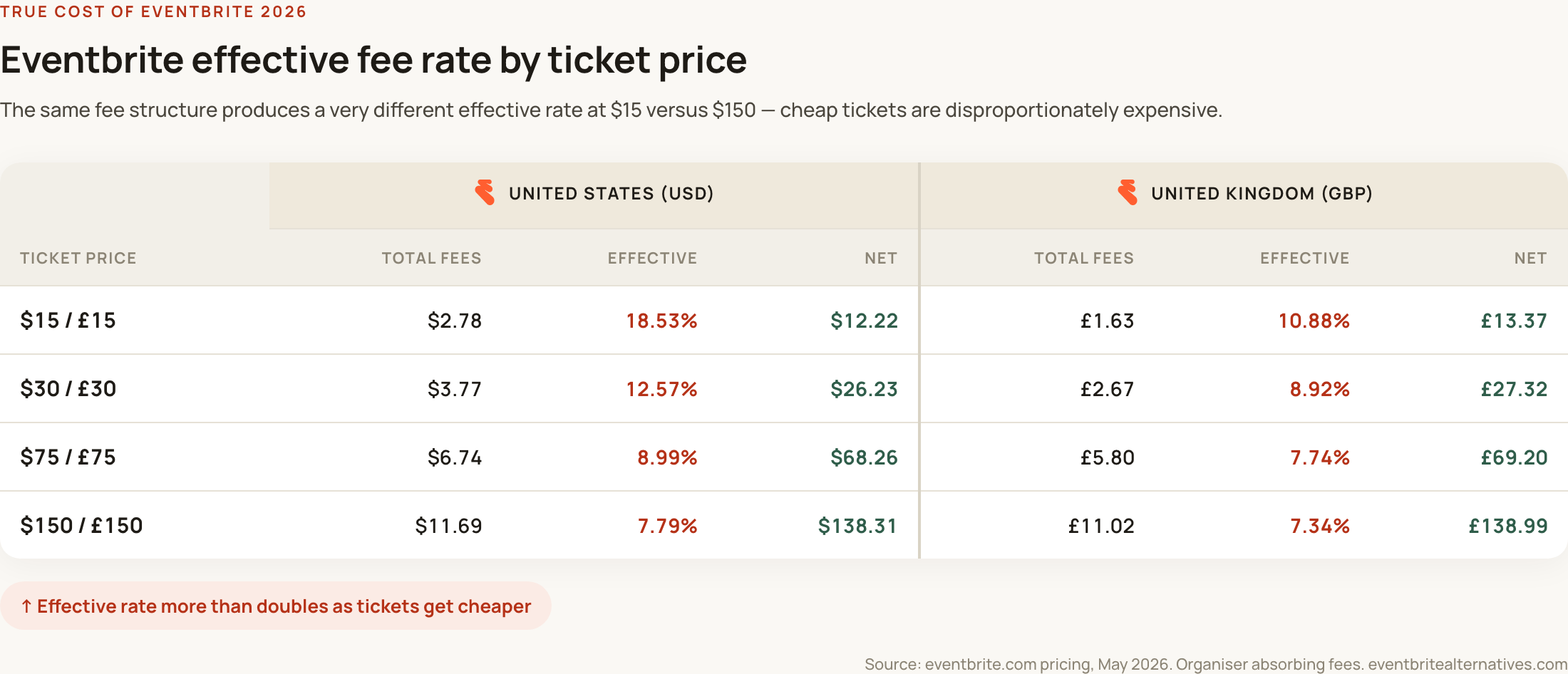
Two patterns stand out.
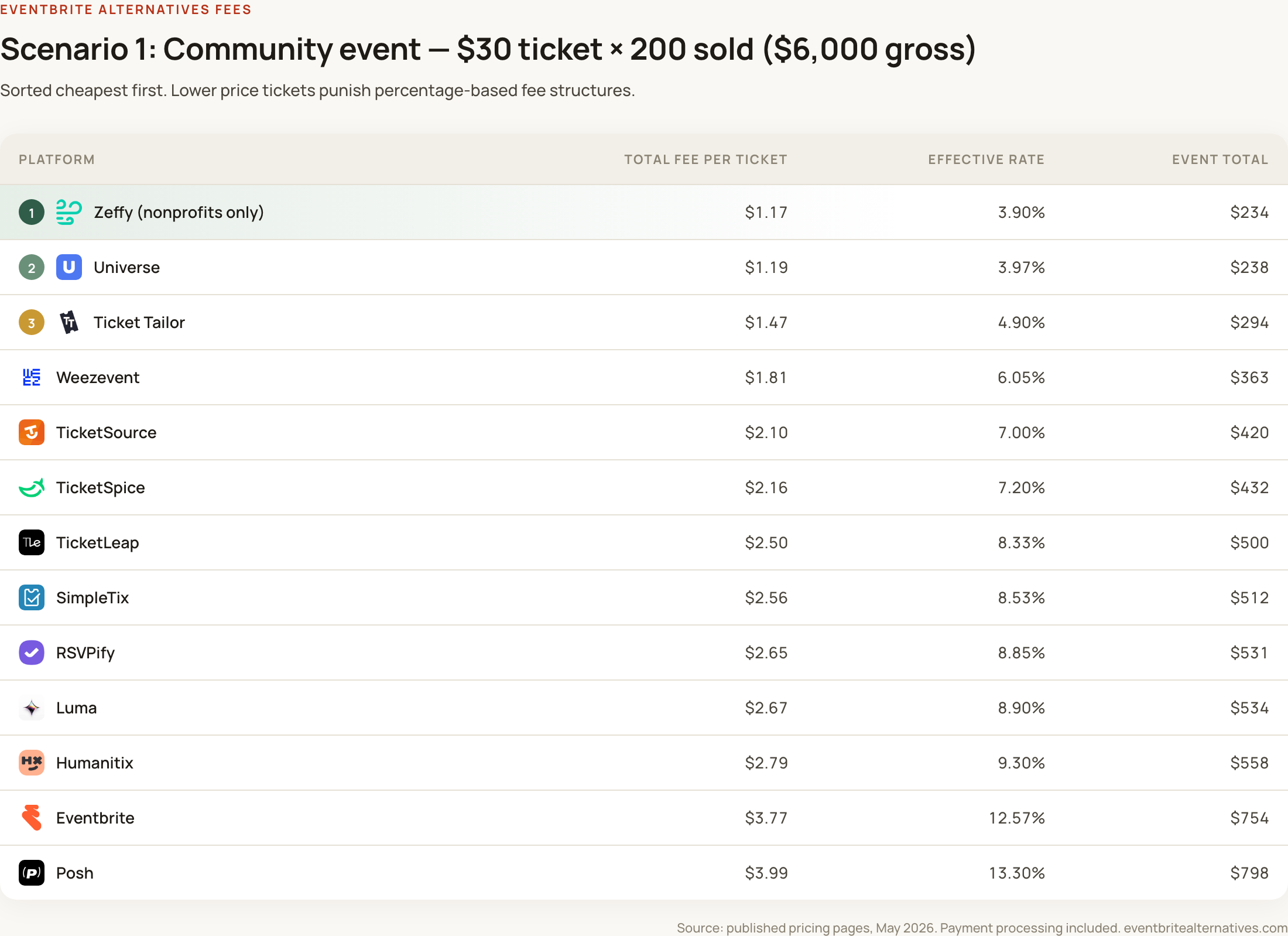
The first is that cheap tickets are disproportionately expensive on Eventbrite. On a $15 US ticket, the organiser keeps just over 81%, with the $1.79 fixed component alone consuming nearly 12% of the ticket. For community events, low-margin fundraisers, or any organiser running $10–$20 tickets, Eventbrite’s fee structure is structurally hostile.
The second is that the cost compounds at scale. A 200-ticket event at $50 per ticket pays Eventbrite $1,018 in fees in the US. The same event at 1,000 tickets pays $5,090. The number rarely surprises an organiser the first time they sell 50 tickets. It almost always surprises them the first time they sell 500.
The fees you only discover later
The headline service and processing fees are the bulk of what Eventbrite charges, but they are not the entire story. Several other costs appear in specific situations and are easy to miss when comparing pricing pages.
Refunds and cancellations. Eventbrite’s service fees are non-refundable. If you refund a ticket, you refund the face value to the buyer, but Eventbrite keeps its cut. For an event with a refund rate of even 5%, this turns the fee structure asymmetric: you pay Eventbrite on every ticket sold, including the ones that did not generate any net revenue. The same applies if you have to cancel the event itself; Eventbrite’s published policy is that service fees are retained.
Chargebacks. If a buyer disputes a charge through their card issuer, Eventbrite typically passes through the underlying payment processor’s chargeback fee (commonly $15–$25 per dispute) regardless of whether the dispute is upheld in the organiser’s favour. This rarely affects most events, but for high-volume or low-trust ticket sales it can become a meaningful line item.
Eventbrite Pro. This is a separate subscription, starting at $15 a month and scaling to $100 a month, that unlocks higher-volume email marketing tools, additional automation, and sponsored placement options. It does not reduce per-ticket fees. Most organisers do not need it; those who do should treat it as a discrete cost, not a fee variant. Nonprofits receive a 50% discount on Pro plans, which is the only official fee reduction Eventbrite offers.
Eventbrite Ads and sponsored placements. Paid promotion within Eventbrite’s marketplace is a separate ad spend, billed independently of per-ticket fees. Starting prices are listed on the Eventbrite pricing page; actual spend varies by category, location and competition.
Currency conversion. Eventbrite supports a range of currencies, but transactions in a currency other than your payout currency incur a foreign exchange margin charged by the underlying payment processor. This is typically 1–2% and rarely surfaces on a pricing page.
Premium (enterprise) plans. For organisations selling at significant volume, Eventbrite offers a custom-quoted Premium plan with negotiated rates, dedicated account management, and additional functionality. The terms are not public, but the existence of the tier confirms that the standard per-ticket fee is not the entire commercial relationship for the largest customers.
None of these are hidden in any deceptive sense. They are visible to anyone willing to read the pricing page, the help centre articles on refunds and chargebacks, and the Pro / Ads documentation. The point is that the headline service fee on the front page is one input to your total cost of using Eventbrite, and rarely the only one.
Working out your own number
A useful exercise for any current Eventbrite organiser is to calculate the platform’s actual annual share of your revenue. The formula is straightforward.
For US organisers absorbing fees:
(Average ticket price × 0.037 + $1.79 + average ticket price × 0.029) × annual tickets sold
For UK organisers:
(Average ticket price × 0.0695 + £0.59) × annual tickets sold
Add to that any Pro subscription, ad spend, and FX margin on international sales. The resulting number is what Eventbrite costs you over a year, and it is almost always larger than the figure an organiser would estimate from memory.
Three questions help interpret the result:
- 1. What proportion of my revenue does Eventbrite take? If your average ticket sits in the $15–$30 range, the effective rate is likely 12–18%. If you sell mostly $75+ tickets, it falls to 8–9%. Either is a defensible cost if the platform genuinely delivers value; both are worth understanding before signing up to another year.
- 2. What am I getting for that? Eventbrite’s marketplace, with its 89 million monthly users, is the strongest argument for the fee. Discovery, brand familiarity, integration ecosystem, and a polished mobile app are real benefits. Whether they justify your specific rate depends on whether your event needs marketplace discovery or whether you drive your own traffic.
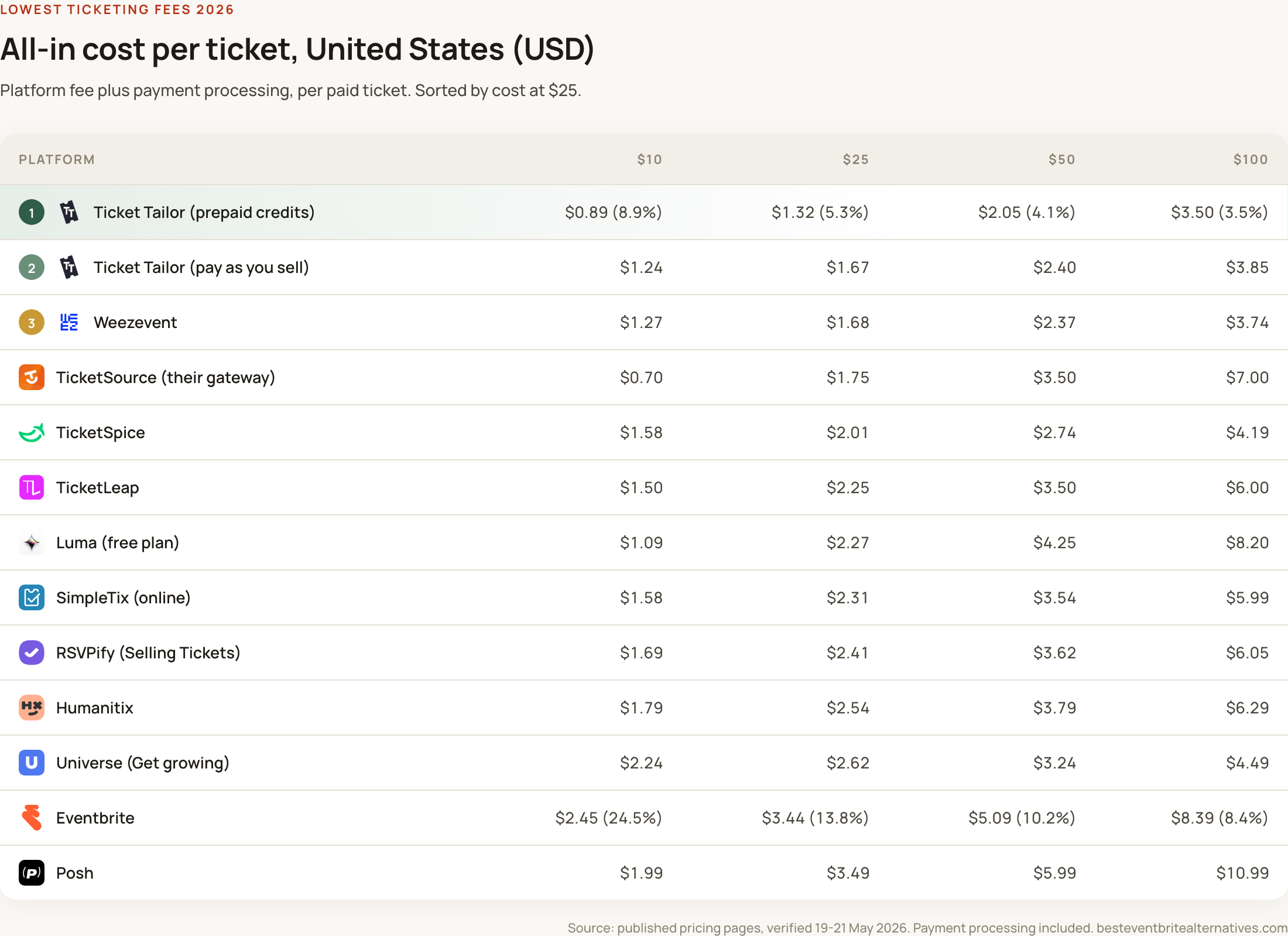
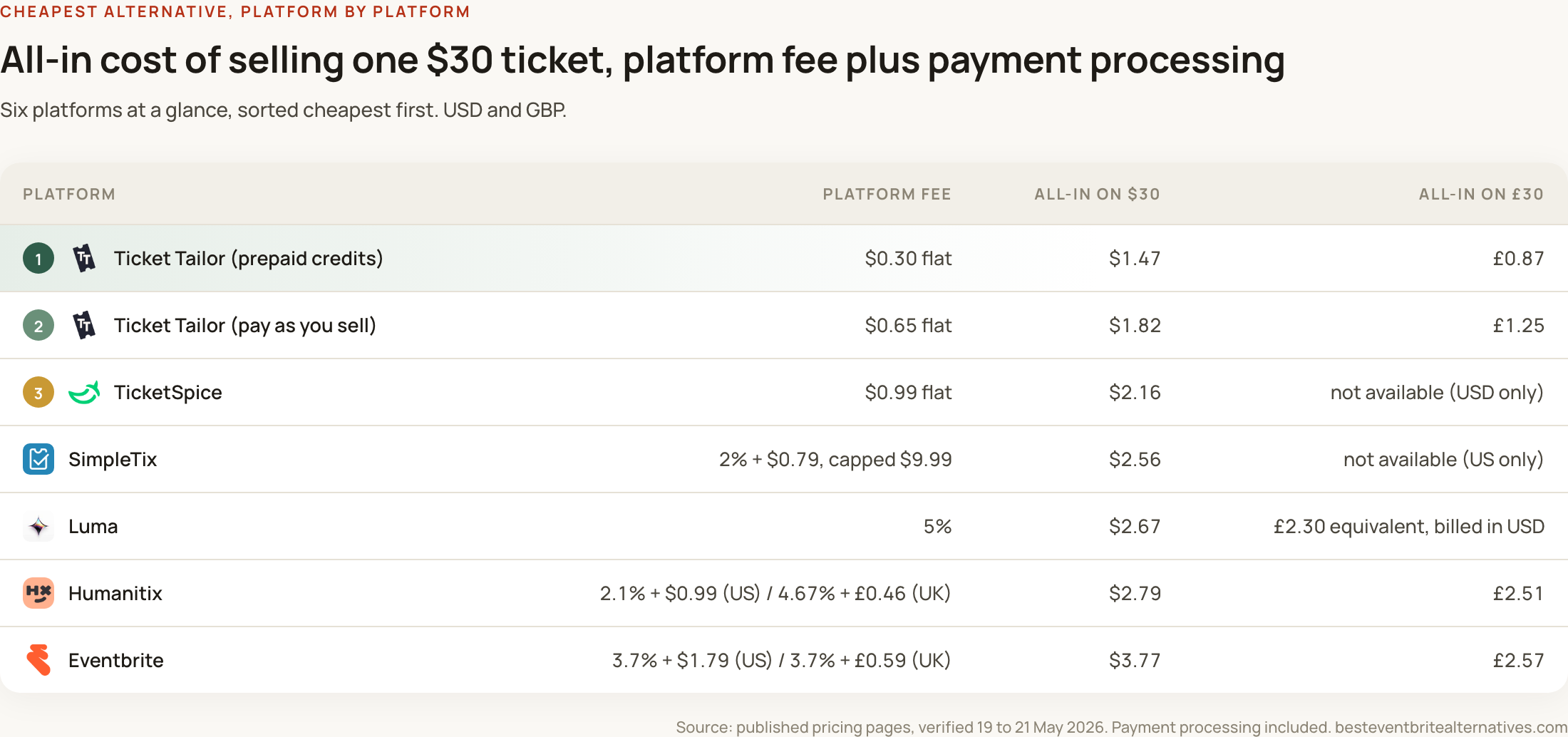
- 3. What would the same event cost on a different platform? This is the question the rest of the ticketing industry is built around. The relevant numbers depend on whether you sell cheap or premium tickets, whether you need a marketplace, and which features you actually use. Our calculator answers this side-by-side across thirteen platforms.
What this means in practice
Eventbrite’s pricing is fair to call transparent, in that every component is published. It is fair to call expensive, in that on most ticket prices the effective rate runs higher than the casual reader of the pricing page would assume. Both things can be true.
For organisers running ticketed events at scale, the question is not whether to use Eventbrite but whether to use it for everything. The marketplace and discovery layer have a real value that smaller platforms do not match. The per-ticket cost is meaningful enough that organisers selling primarily to existing audiences may find the value proposition does not justify the rate.
The wider self-service ticketing market in 2026 includes platforms charging anywhere from a few percent (Humanitix, SimpleTix, TicketSource) to flat per-ticket fees (Ticket Tailor, TicketSpice) that, for higher-priced tickets in particular, work out substantially below Eventbrite’s effective rate. Whether the difference matters to a given organiser depends on the same three questions above. The most useful first step is knowing your own number.