Which ticketing platform has the lowest fees? An honest answer
Thirteen Eventbrite alternatives compared on real numbers across three realistic event scenarios, plus a framework for working out which is cheapest for your event.
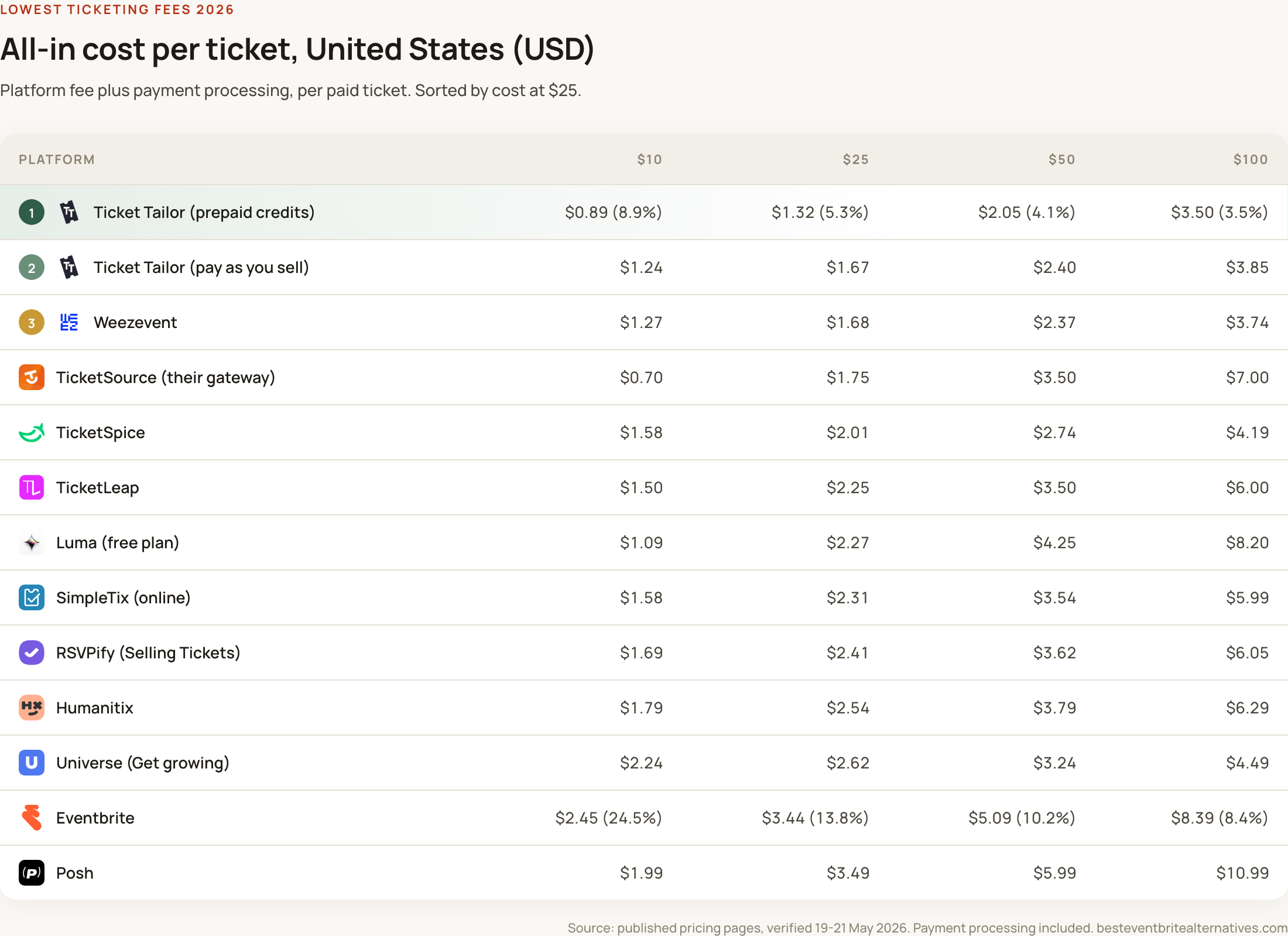
Search for the cheapest event ticketing platform and almost every result will hand you a single name. It is usually the platform that owns the article. The reality is more useful, if less clickable: there is no universal “lowest fee” platform, because fees are calculated in three different ways, and which one wins depends entirely on what you are selling.
This piece does something different. It lays out the published fees of thirteen well-known ticketing platforms, shows the maths across three realistic event scenarios, and gives you a way to work out which platform is cheapest for your event rather than someone else’s.
A few ground rules before we start. All figures are current as of May 2026, drawn from each platform’s published pricing page. Payment processing is included in every calculation, because excluding it produces misleading comparisons (a platform that bundles processing into one rate is not magically cheaper than one that separates it out). Where a platform offers multiple plans, we have used its standard self-serve plan, since that is what most organisers actually sign up to. Currency is noted throughout: USD for North American figures, GBP for UK figures.
Three fee models, not one
Almost every ticketing platform uses one of three pricing structures.
Flat per-ticket. A fixed fee on each ticket sold, regardless of price. Ticket Tailor’s default plan and TicketSpice work this way. Flat fees become disproportionately cheap as ticket prices rise, because the fee stays the same whether you sell a £10 or £150 ticket.
Percentage plus fixed. A percentage of the ticket price plus a small fixed amount per ticket. Eventbrite, Humanitix, Universe, SimpleTix and most others use some version of this. Percentage models scale with revenue, which sounds fair until you realise it punishes premium events: the more you charge, the more the platform takes.
Percentage with a cap. A few platforms (Universe, SimpleTix, TicketLeap) apply a percentage with a per-ticket maximum. This produces interesting results: cheap on high-priced tickets where the cap kicks in, expensive on mid-priced tickets where it does not.
A fourth model exists in name only: “free for organisers” platforms like Zeffy, which charge donors a default tip (often around 17%) that funds the platform. The cost has not disappeared; it has been moved.
The platforms, briefly
What follows are the headline fees for each platform’s default plan. Detail and edge cases follow in the worked examples.
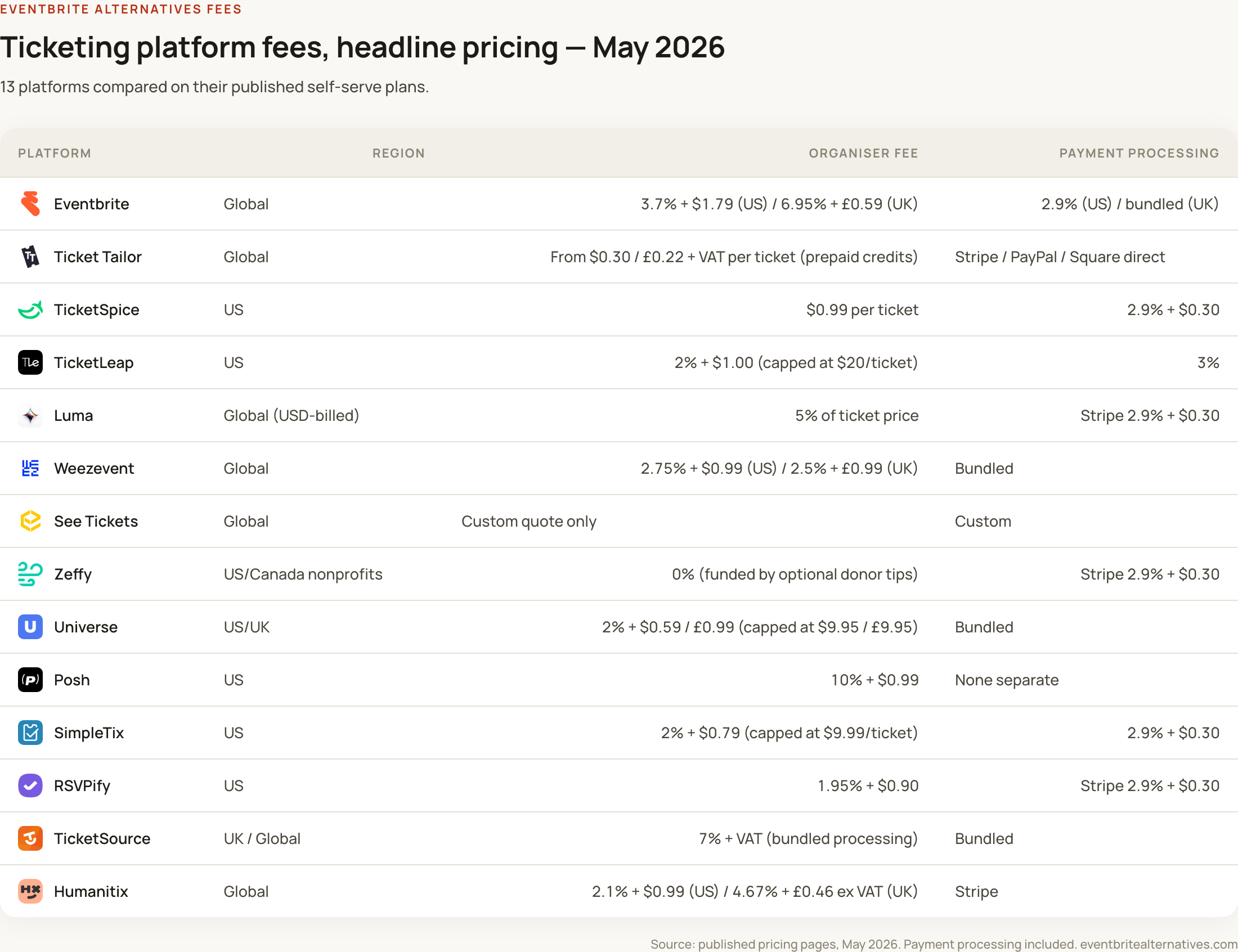
*UK Eventbrite pricing is a combined rate with no separate processing fee.
A few of these need quick context. See Tickets does not publish standard fees and works on a custom quote model, which makes it impossible to compare like-for-like. Zeffy is restricted to verified US and Canadian nonprofits. Posh is heavily oriented toward nightlife and Gen Z social events. Universe is owned by Ticketmaster, which some organisers treat as a feature and others as a deal-breaker. Luma’s headline fees omit email sending costs, which are heavily metered and can run from $50 to $800 a month for organisers who actually use their attendee list.
Three scenarios, real numbers
Headline fees only get you so far. To see which platform is genuinely cheapest, we need to work the numbers across realistic events. Each scenario below assumes the organiser absorbs fees (the more demanding accounting question). All figures are in USD using the default plan in each platform’s pricing table. Payment processing is included.
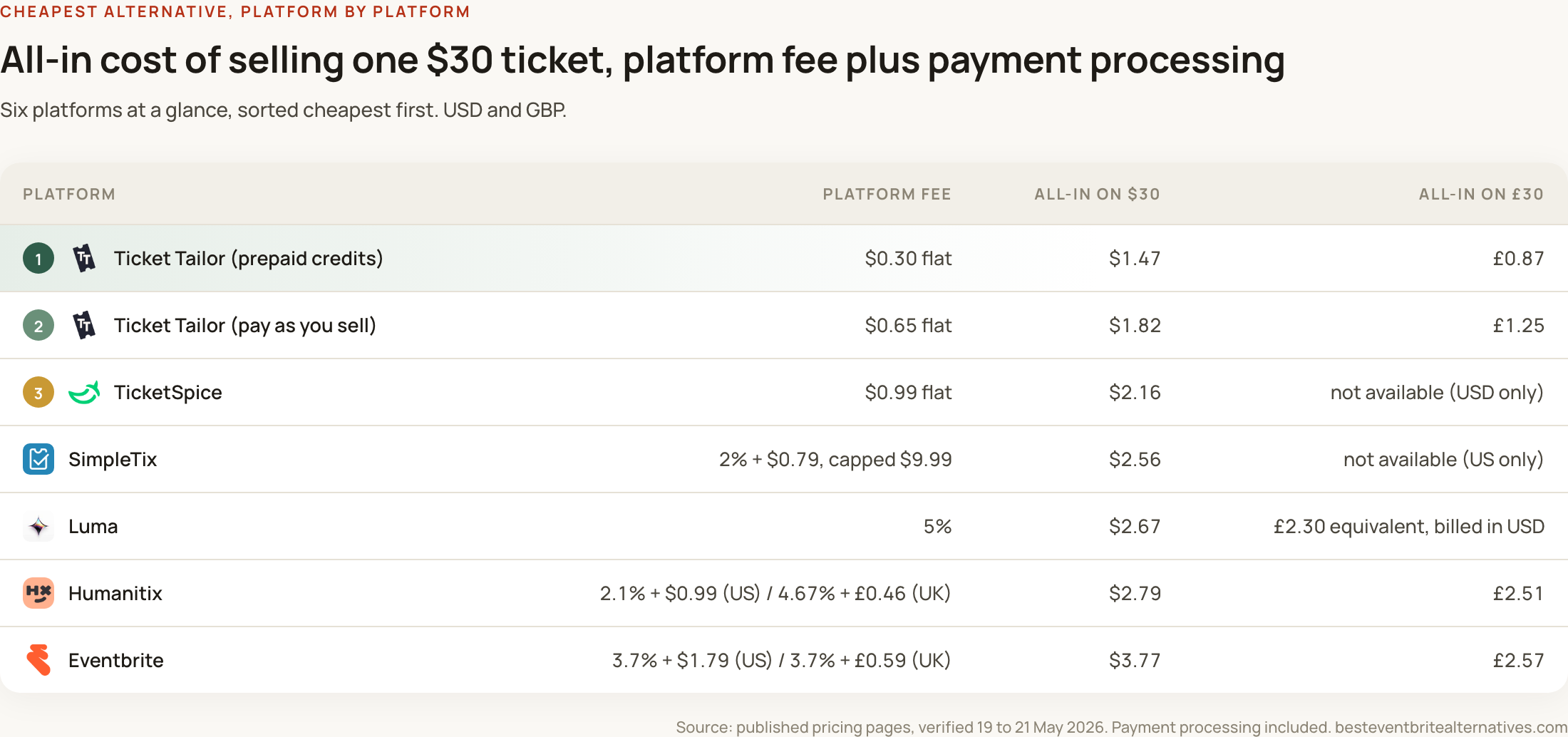
Scenario 1: Community event ($30 ticket × 200 sold, $6,000 gross revenue)
This is the typical first-time organiser profile: a workshop, fundraiser, small festival, community meeting.
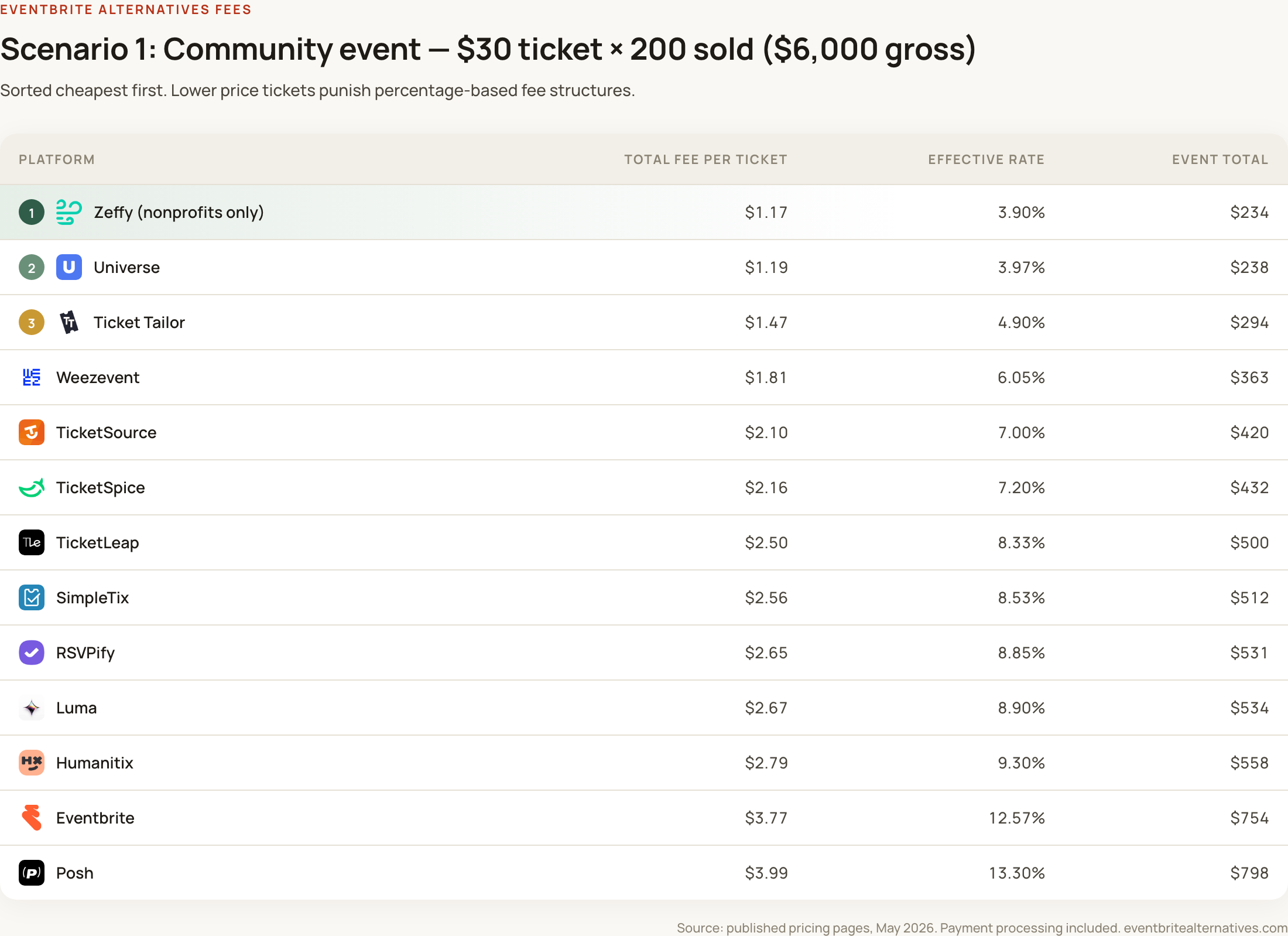
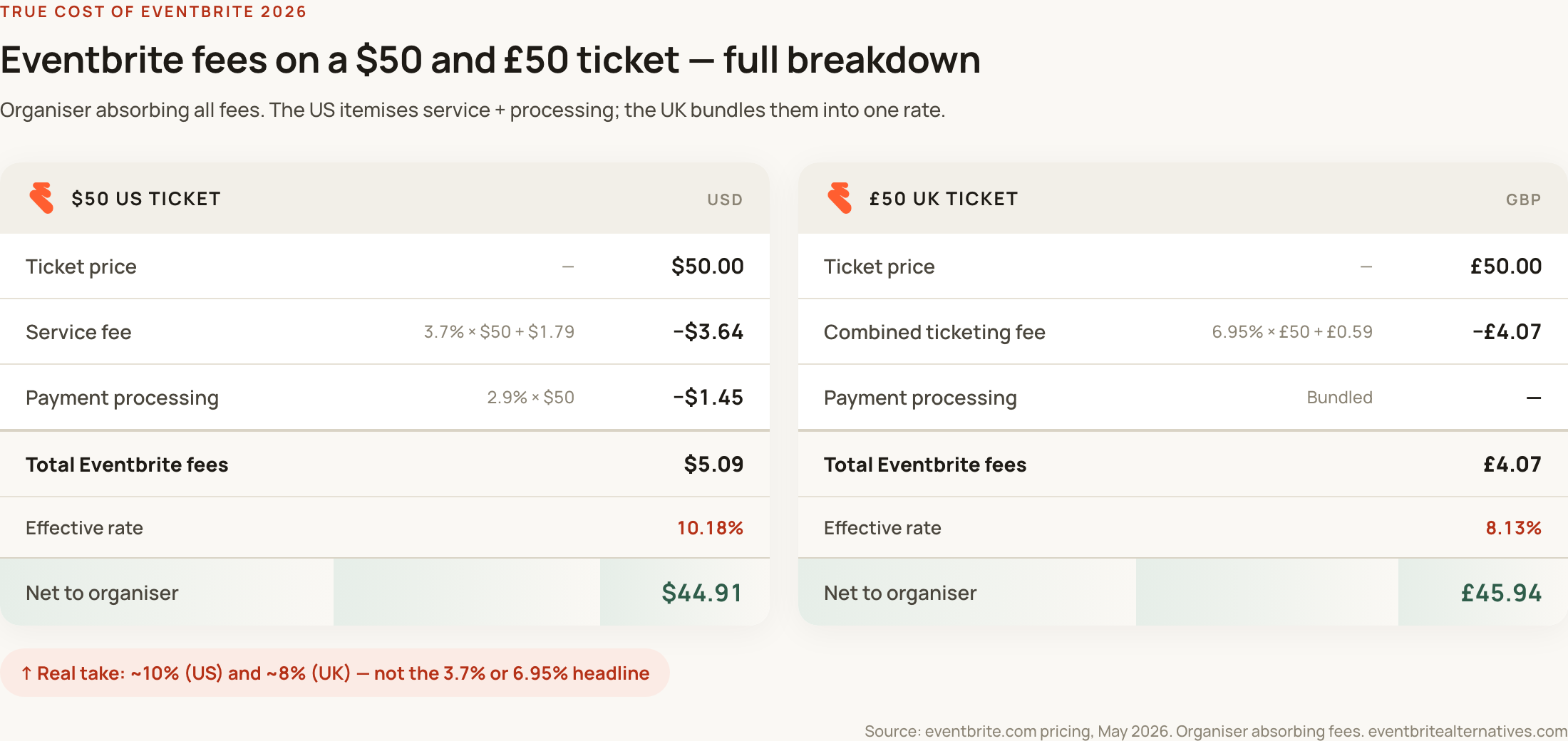
The headline reading is that low-priced tickets punish percentage-based fee structures hard. Eventbrite’s fixed $1.79 per ticket alone is 6% of a $30 ticket, before any percentage is applied. Posh’s 10% cut makes it the most expensive on the table by a margin.
At this end of the market, flat-fee or bundled platforms dominate. Zeffy is the cheapest if you qualify, but the optional donor tip (typically suggested at 17% of the order) will eat the saving for most events unless donors actively edit it down. Universe and Ticket Tailor’s prepaid-credit rate are the next two cheapest for organisers without nonprofit status.
Scenario 2: Mid-priced event ($75 ticket × 100 sold, $7,500 gross revenue)
A boutique conference, a guided tour, a half-day training course.
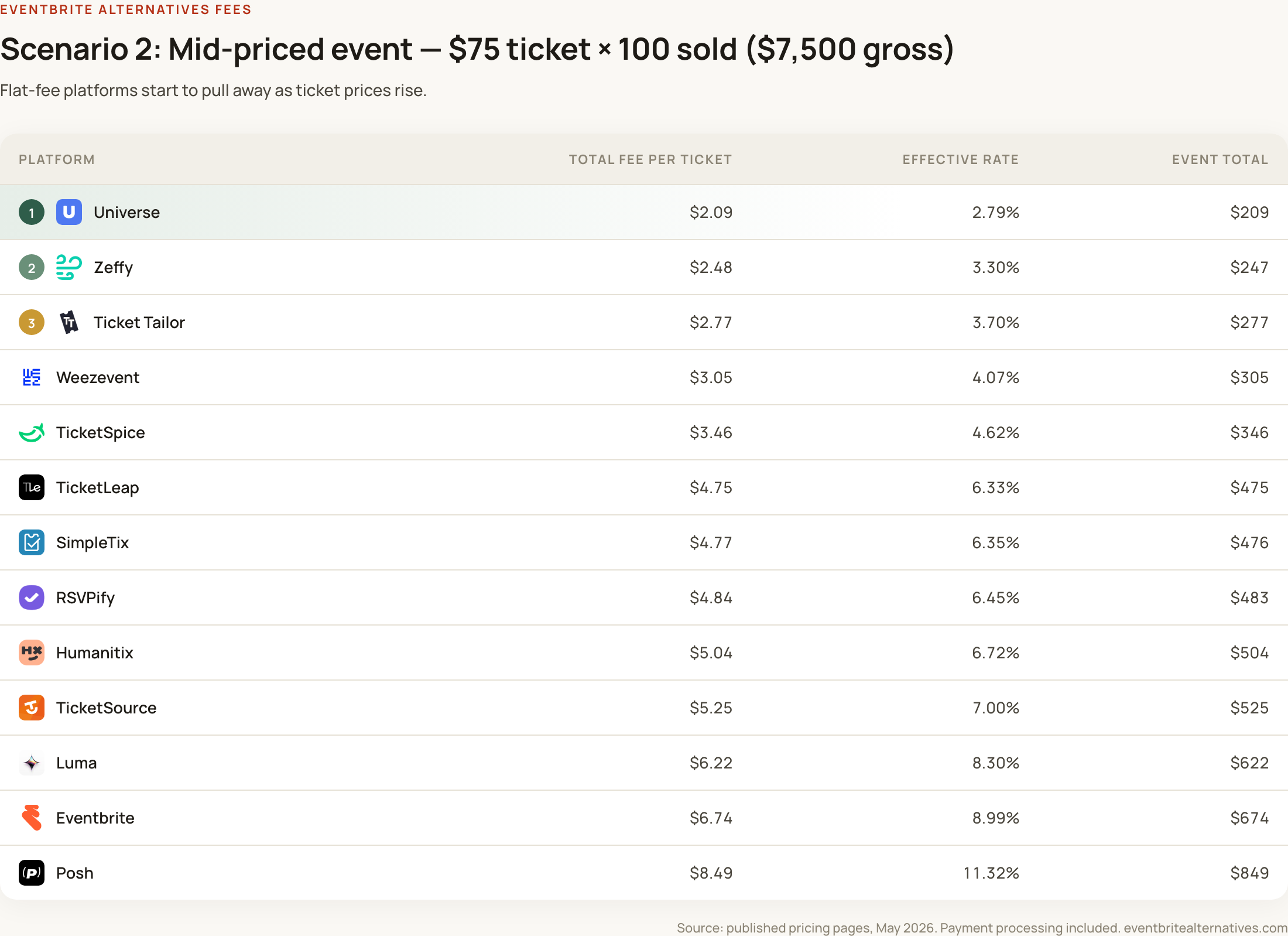
At this price point, the maths shifts. Flat-fee platforms (Ticket Tailor, TicketSpice) start to pull away from percentage models because their fee stays constant while everyone else’s grows. Universe is still the cheapest commercial option because its low percentage combined with bundled processing produces a tight effective rate. Eventbrite’s percentage component starts to bite harder.
Scenario 3: Premium event ($150 ticket × 50 sold, $7,500 gross revenue)
A VIP dinner, a one-day executive workshop, a high-end retreat.
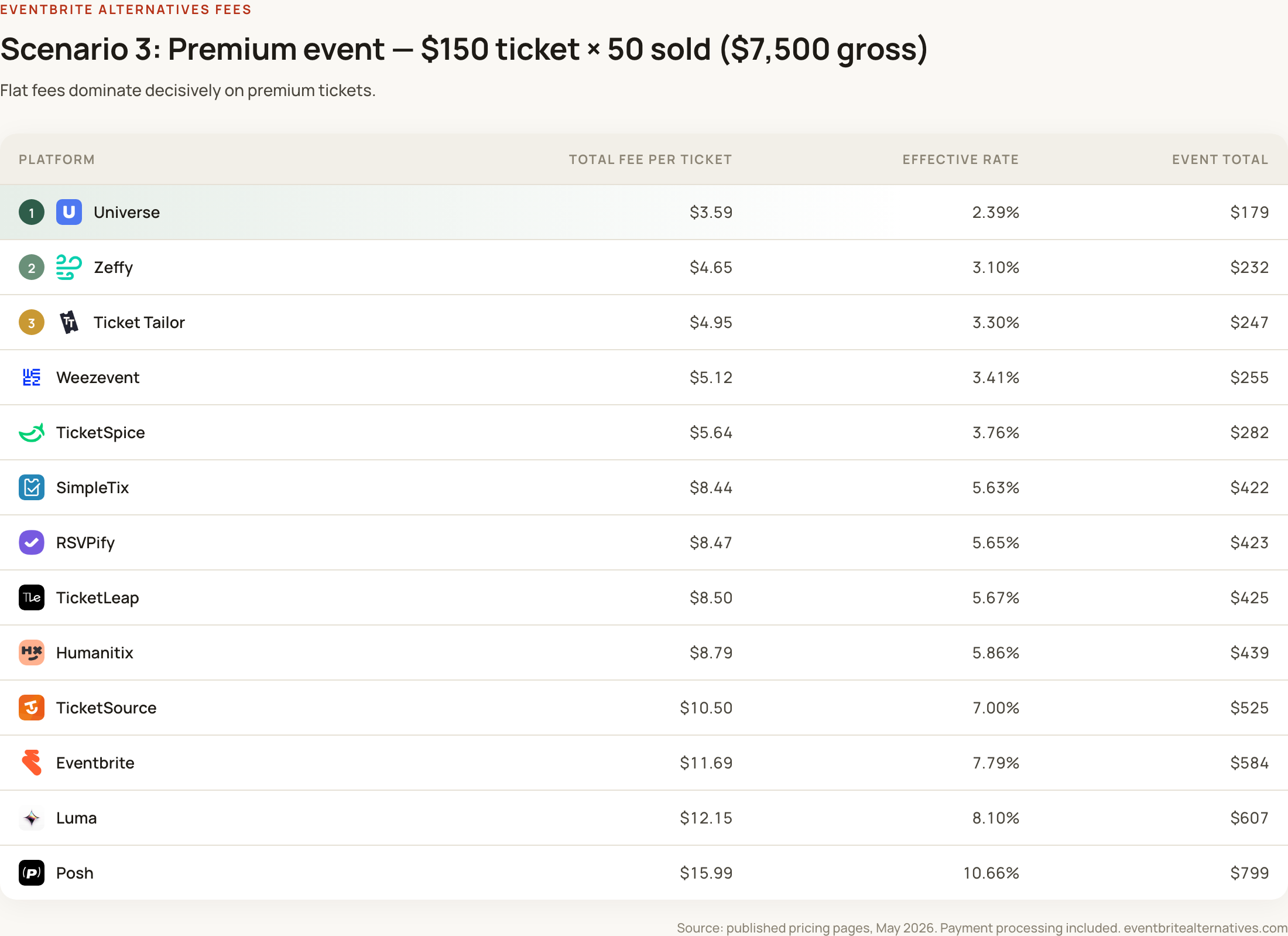
Here the flat-fee model wins decisively. Ticket Tailor charges $4.95 per ticket on a $150 sale because the platform fee is $0.30. Eventbrite charges $11.69 on the same ticket. On a 50-ticket event the difference is $337. On a 500-ticket event of the same kind the difference would exceed $3,300.
What the three scenarios tell us
The same thirteen platforms ranked differently across the three scenarios. That is the point.
Universe came first in all three. This is partly because its $9.95 per-ticket cap kicks in early and partly because its bundled rate undercuts platforms that show processing separately. The Ticketmaster ownership and the “Get growing” plan with its higher 5.5% fee are caveats worth knowing, but on the published self-serve plan, the numbers stand up.
Ticket Tailor and TicketSpice get cheaper as tickets get more expensive. This is the flat-fee story. If you sell premium tickets, a flat fee almost always wins.
Eventbrite is consistently in the most expensive third of the list. Its global brand recognition and marketplace remain its strongest arguments, but on fees alone, it is not competitive.
Posh and Luma are surprisingly expensive. Posh’s 10% headline tells you everything. Luma’s 5% looks reasonable until you remember that its email-sending costs are not included and that most organisers will trigger paid tiers within a couple of moderately-sized events.
Zeffy is a special case. The 0% to the organiser is real, but the platform survives on donor tips that default to roughly 17% of the order value. Donors can edit the tip down to zero, but most do not. The genuine cost of Zeffy is therefore somewhere between zero and 17%, depending entirely on how price-sensitive your supporter base is.
Why fees are not the only question
This piece has spent a lot of words on numbers, but the editorially honest answer is that “lowest fee” is rarely the right brief.
Three other factors matter at least as much, and sometimes more.
Payouts and cash flow. Eventbrite pays out five to seven business days after the event ends. Some platforms (Ticket Tailor, TicketSource, SimpleTix on its own merchant model) let funds flow directly to your bank as tickets sell, which can be the difference between paying suppliers on time and not. For an event with significant upfront costs, payout timing is a real cost in its own right.
Data ownership and marketing. Eventbrite and Universe operate marketplace models where your attendee data is co-owned by the platform, which uses it to promote other events to your audience. For independent organisers building a long-term customer base, this is a meaningful trade-off. Platforms like Ticket Tailor, TicketSpice, Humanitix and TicketSource leave attendee data with the organiser.
Discovery. Eventbrite’s marketplace is the strongest argument in its favour, despite the fees. If you genuinely need to reach an audience that does not already know you exist, the platform’s eighty-nine million monthly users represent real discovery potential. Most other platforms do not offer this and assume you will drive your own traffic.
Support and reliability. Worth saying plainly: at three a.m. the night before doors open, a platform with twenty-four-hour support is worth a great deal more than one that saves you forty pence per ticket. Reviews on G2, Capterra and Trustpilot are a more useful read on this than any pricing page.
A short framework
Before signing up to any platform, work through three questions.
- 1. What is your average ticket price, and how many tickets will you sell? Multiply them, run the numbers against three or four platforms on your shortlist, and you will have a defensible number. Most platforms publish calculators; if not, the formulae are simple enough to do in a spreadsheet in ten minutes. Try ours.
- 2. Who pays the fees, you or the buyer? Passing fees to the buyer makes the fee structure largely irrelevant to your bottom line, though it can dent conversion at the higher rates. Absorbing fees makes the numbers above directly your problem.
- 3. What else does the platform need to do? If you need reserved seating, recurring events, memberships, donations, multi-currency support, on-site box-office, hardware integrations or marketplace exposure, the cheapest platform that does not offer those features is not actually cheap.
The lowest-fee platform for any given event exists. It is just rarely the same one twice.