Flat fee vs percentage: which pricing model actually saves you money
Flat-fee platforms beat percentage-plus-fixed on almost any ticket above $20, but capped percentage models flip the maths at the premium end. Three models, two worked tables, and a short framework.
The headline argument is familiar. Flat-fee ticketing platforms tell you that percentage models punish your success: the more you sell, the more they take. Percentage-fee platforms tell you that flat fees are unfair to low-priced events and that paying a small share of revenue is the only honest way to price. Both are right about each other. Neither is telling you the whole story.
The truthful answer is that the cheapest pricing model for your event depends on three things: your ticket price, your volume, and which specific platforms you are comparing. Run the numbers across the major ticketing platforms and the “flat versus percentage” debate dissolves into a more interesting question: at what point does each model genuinely save you money, and where is the marketing simply hoping you will not check?
The three models you will actually encounter
Most ticketing pricing pages use one of three structures, often dressed up with different language.
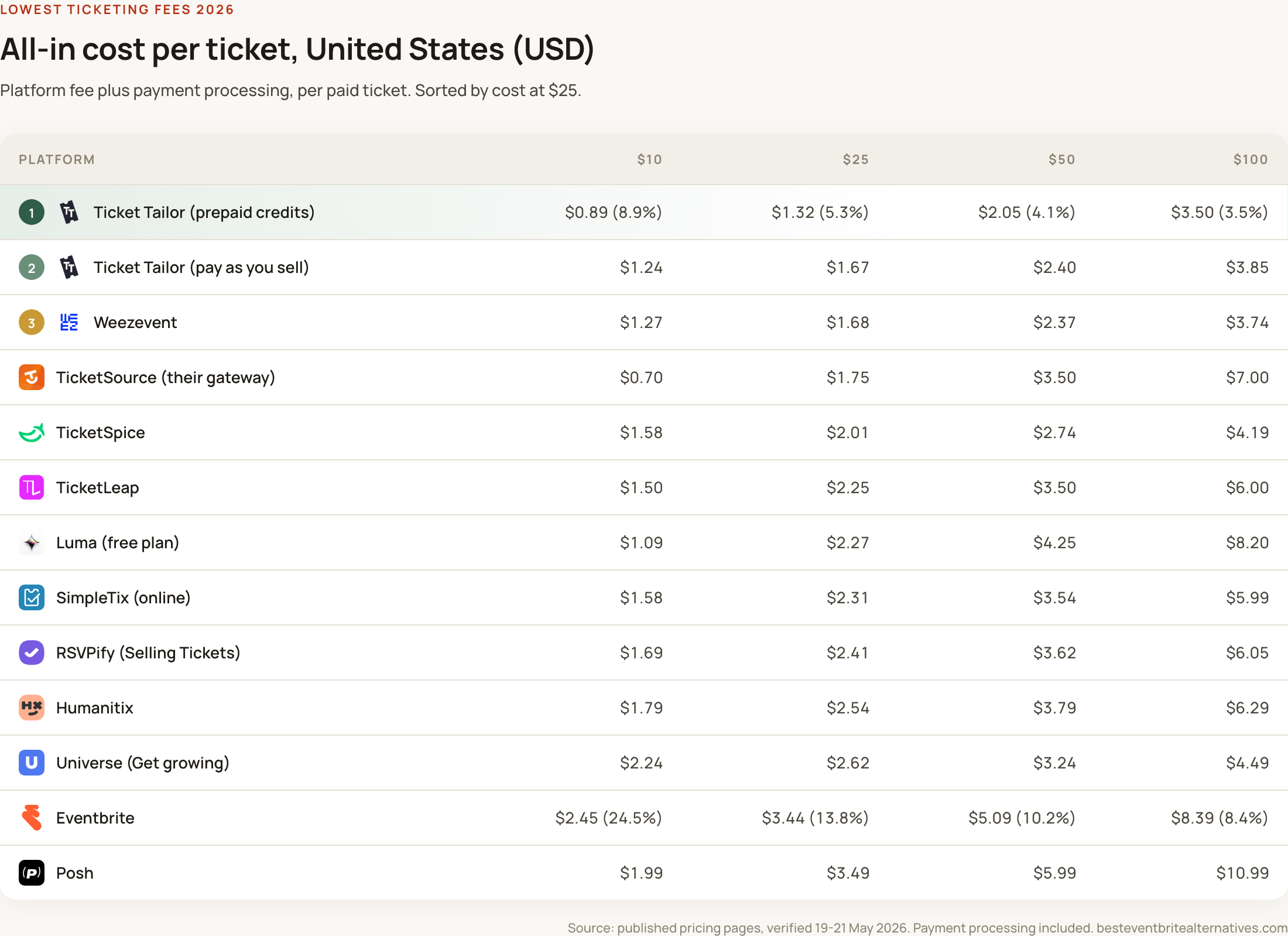
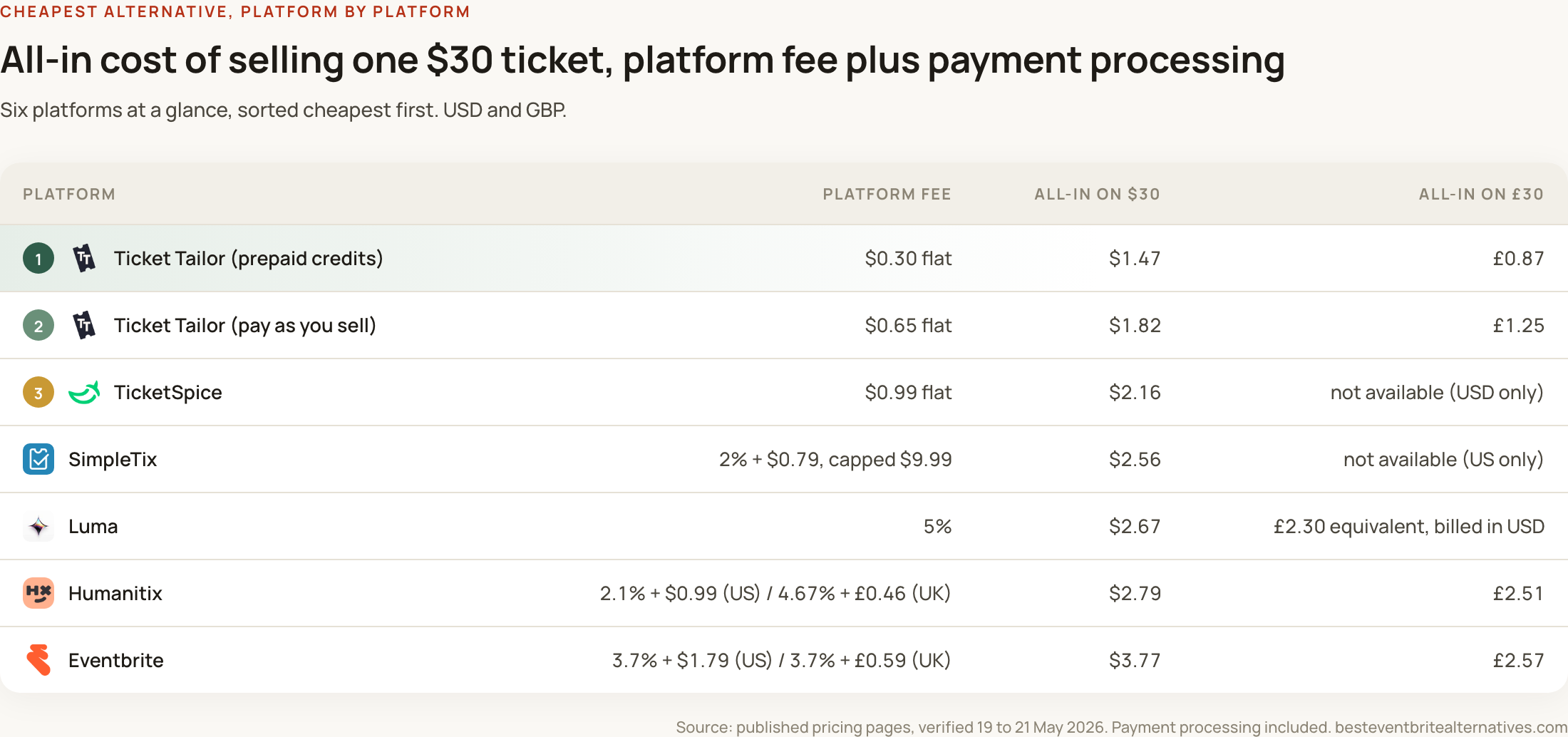
Flat per-ticket fee. A fixed amount on every paid ticket sold, regardless of ticket price. Ticket Tailor’s default plan charges from $0.30 per ticket in the US and from £0.22 + VAT in the UK on prepaid credits. TicketSpice charges $0.99 per ticket. Both add standard payment processing on top (typically Stripe at 2.9% + $0.30 in the US, or 1.5% + £0.20 in the UK). The platform fee does not change whether you sell a $10 or a $250 ticket.
Percentage plus fixed. A percentage of the ticket price plus a small fixed amount per ticket, typically with separate payment processing on top. Eventbrite (3.7% + $1.79 + processing), Humanitix (2.1% + $0.99 + processing), and most other major platforms use a version of this. The percentage scales with price; the fixed amount disproportionately affects cheap tickets.
Percentage with a cap. A few platforms (Universe, SimpleTix, TicketLeap) apply a percentage with a per-ticket maximum. Universe charges 5.5% + $0.99 in the US and 5.5% + £0.99 in the UK with a $9.95 / £9.95 per-ticket ceiling. SimpleTix charges 2% + $0.79 capped at $9.99. TicketLeap charges 2% + $1.00 capped at $20. Caps quietly change the maths: the model behaves like a percentage at low prices and like a flat fee once the cap kicks in.
There is also a fourth model worth mentioning. Some platforms advertise “0% for organisers” and recoup costs from buyers, either through donor tips (Zeffy) or by passing all fees to the attendee at checkout. The cost has not disappeared in either case; it has moved.
Where flat fees genuinely save money
The strongest case for flat fees is high-priced tickets. The maths is unsentimental.
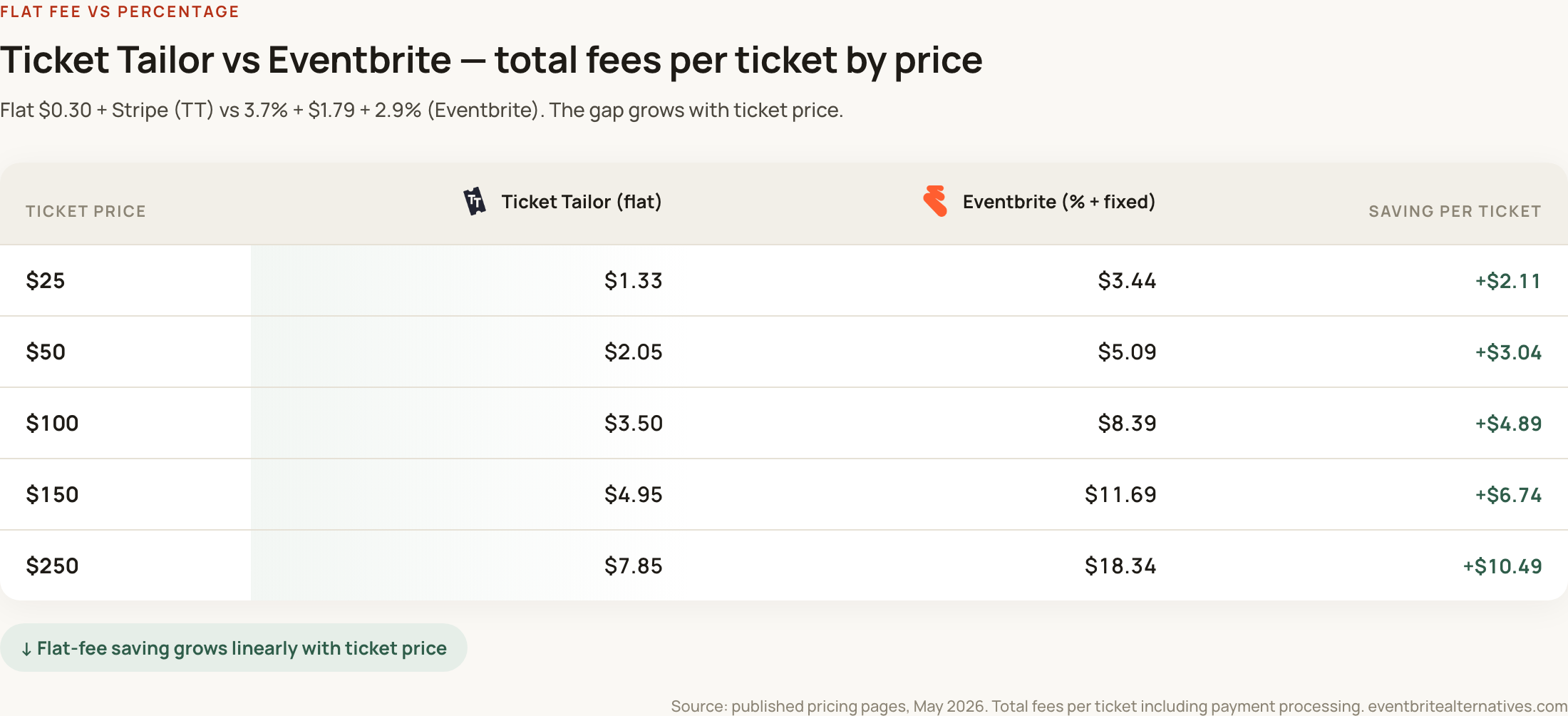
A $150 ticket on Ticket Tailor’s prepaid credits plan costs $4.95 in total fees (the $0.30 platform fee plus Stripe’s 2.9% + $0.30 processing). The same ticket on Eventbrite costs $11.69 ($5.55 in platform fees plus $1.79 fixed plus $4.35 processing). The flat-fee organiser keeps an extra $6.74 per ticket. On a 200-ticket VIP dinner, that is $1,348 retained.
The gap widens further at premium prices. A $300 ticket on Ticket Tailor’s plan still costs $9.30 in total fees. The same ticket on Eventbrite costs $21.59. The structural reason is simple: Eventbrite’s 3.7% takes $11.10 from a $300 ticket. Ticket Tailor’s flat fee takes 30 cents. Both platforms still charge payment processing, but processing is roughly equal across the industry.
The gap exists at every price point, but it is most meaningful where it is largest:
For an organiser running premium events, the flat-fee model is not marginally cheaper. It is structurally different.
Where the case for flat fees gets weaker
The case loses force in two scenarios.
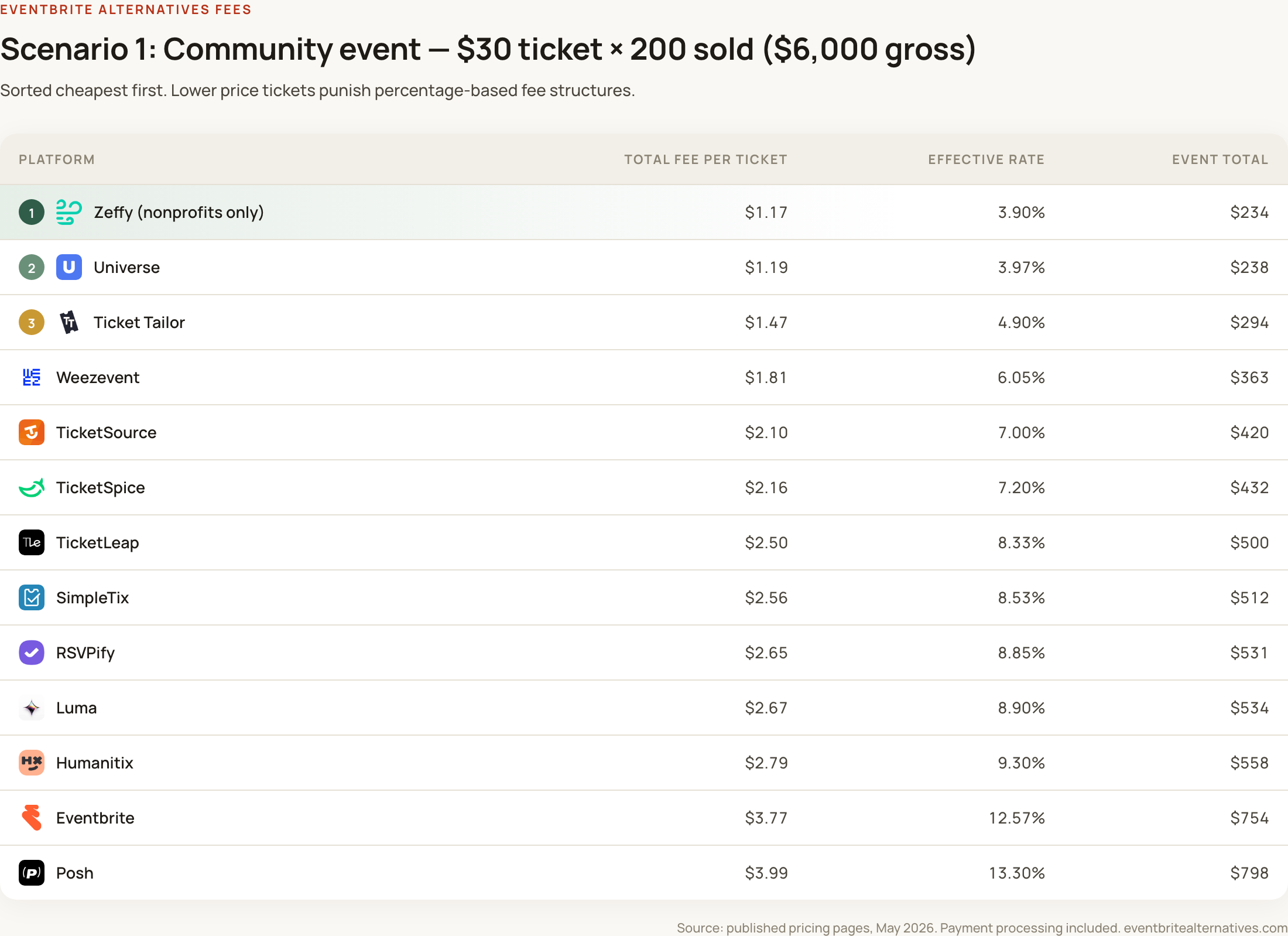
Cheap tickets where a flat fee is a large share of the price. TicketSpice charges $0.99 per ticket. On a $5 community event, that is 19.8% of the ticket price before processing is added. A percentage platform with no large fixed component (Humanitix at 2.1%) will be cheaper at this end of the market. The same is true for free events with optional donations, where any per-ticket fee feels disproportionate. Most flat-fee platforms address this by waiving fees on genuinely free events, but the model breaks down for $1 and $2 tickets.
Very high-priced tickets where a percentage cap kicks in. Capped percentage platforms behave like a percentage at typical event prices and switch to behaving like a flat fee once the cap triggers. Universe’s cap is $9.95 per ticket in the US, which means its fee stops growing at around $164 per ticket. Below that price point, Universe’s 5.5% + $0.99 rate is steeper than most flat-fee alternatives. Above the cap, the maths starts to favour it.
Run the comparison across the price spectrum:
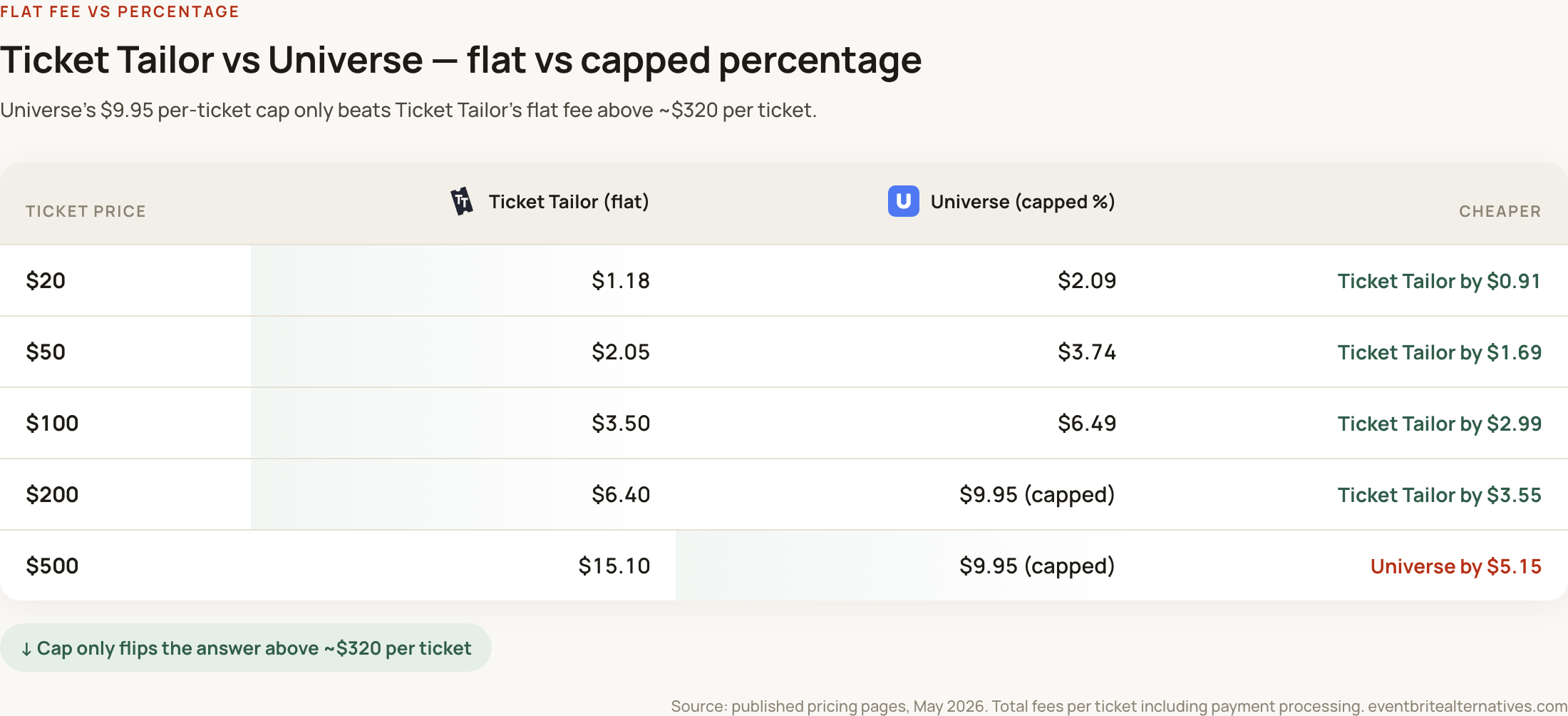
The flat fee beats the capped percentage at every realistic event price up to roughly $320. Above that, Universe’s cap holds steady at $9.95 while Ticket Tailor’s payment processing component (2.9% of price + $0.30) keeps growing. For the small minority of organisers running $400-plus VIP tickets, the capped model edges ahead.
The broader point is that even with a per-ticket cap, a percentage model rarely beats a low flat fee across the full range of typical events. Where it does win, the audience is narrow: high-priced premium tickets at the top end of the market.
It is also worth flagging that Universe is owned by Ticketmaster, which some organisers treat as a feature (discovery reach, brand familiarity) and others as a deal-breaker (data ownership, marketplace cross-promotion). That is a separate conversation from the fee maths.
The “0% for organisers” trick
A handful of platforms market themselves as free. The mechanism varies.
Zeffy, available to verified US and Canadian nonprofits only, charges no platform fee and survives on optional donor tips (suggested at around 17% of the order value, donor-editable down to zero). If your supporter base reliably tips, Zeffy is genuinely free. If they edit the tip out, it is also genuinely free. In practice, most donors leave the suggested tip alone, which means Zeffy quietly costs nonprofits more than the typical 2 to 3% flat-fee platform would.
Other platforms pass all fees to buyers as a default, advertising the organiser-side rate as zero. This works mathematically but distorts the comparison: the fees are still paid, just by a different person in the transaction. For organisers worried about checkout drop-off (passing fees to buyers does, modestly, reduce conversion at higher rates), the “0%” headline is not actually zero in revenue terms.
The simplest test for any “free” pricing claim is to ask where the money comes from. Software companies do not run themselves on optimism.
Where percentage genuinely wins
It is worth being even-handed. The percentage model has three legitimate advantages.
Risk-sharing at low volumes. If you sell ten tickets at $15, a percentage-based platform takes a smaller absolute amount than most flat-fee platforms. The trade-off is that you pay nothing if you sell nothing, which can matter for first-time organisers testing an idea.
Built-in discovery. Eventbrite, Universe and a few others operate marketplaces where their audience can find your event. The percentage fee partly funds that distribution. Whether marketplace traffic is worth the percentage depends on whether you actually need the discovery; for many established organisers with their own audience, it is not.
Predictability for buyers. A small percentage on every ticket scales with whatever you charge, which means buyers see the same proportional fee on a $10 or $100 ticket. Flat fees produce visibly different percentages at different price points, which can confuse attendees.
A short framework for working out which is cheaper for you
Most organisers can answer this question in a spreadsheet in ten minutes. Three steps:
- 1. Estimate your average ticket price and volume. Round to the nearest $5 or £5; precision matters less than direction.
- 2. Run the maths on three shortlisted platforms using their published fee structures. Include payment processing in every comparison, even where one platform shows it bundled. Excluding processing produces a misleading picture.
- 3. Add the qualitative factors. Payout timing, data ownership, support hours, marketplace discovery, regional payment methods. If two platforms come within 10% of each other on fees, these factors will determine which is actually cheaper to run an event on.
Most ticketing platforms publish their own fee calculator, which is helpful for the platform-versus-Eventbrite comparison they are quietly trying to win. A growing number of independent calculators allow side-by-side comparisons across multiple platforms, which is the more useful tool. If you want to test the maths in this article against your own scenario, our calculator loads all major platforms in one view and will save you the spreadsheet.
The honest summary
Flat fees beat percentage-plus-fixed models on almost any ticket above roughly $20. The gap grows as ticket prices rise and becomes very large above $100.
Capped percentage models can beat flat fees, but only at the top end of the price spectrum. For most events under $300 per ticket, a flat fee remains the cheaper option.
“0% to organisers” rarely means free. The cost has been moved to your buyer or your donor, and the headline number is doing work that the small print quietly undoes.
The cheapest pricing model for your event is not a model. It is a specific platform, on a specific ticket price, at a specific volume. Run the numbers before you sign up.