The FTC junk fees rule, one year on: what changed for event ticketing
The FTC's junk fees rule came into force on 12 May 2025. Twelve months in: the StubHub $10m settlement, the Live Nation/FTC case, the DC settlement, and the state-level surge, plus what it means for organisers comparing platforms.
On 12 May 2025, the Federal Trade Commission’s Rule on Unfair or Deceptive Fees came into force. The rule (commonly called the junk fees rule) requires businesses in two industries, live event ticketing and short-term lodging, to disclose total prices up front, including all mandatory fees, more prominently than any other pricing information. It was the most consequential consumer-pricing rule the FTC had issued in years and was widely understood to be the federal response to a decade of complaints about drip pricing in ticketing and hotels.
A year on, the rule is doing roughly what its backers said it would, partly because of federal enforcement and partly because a parallel surge of state-level legislation and AG-led enforcement has reinforced it from below. This piece reads through the first year of enforcement, picks out what has changed for event ticketing specifically, and considers what the rule means for organisers in 2026 and beyond.
What the rule requires
The mechanics are straightforward. Live event ticketing platforms (and short-term lodging platforms) must:
- Display the total price, inclusive of all mandatory fees, in any advertisement, listing or offer
- Show that total more prominently than any other pricing figure
- Allow optional add-ons to be itemised separately, with a clear explanation of what they are
Government-imposed taxes and shipping charges can still be added at checkout. Anything mandatory, including service fees, payment processing fees, convenience charges and “facility” fees, must be in the headline price.
Civil penalties for violations can run up to $51,744 per breach. Each ticket advertised or sold with a non-compliant price disclosure is a separate violation, so the penalty mathematics scale quickly for high-volume platforms.
The rule was a Biden-era initiative finalised in December 2024 and came into force under the Trump administration in May 2025. It has received continued support under the current administration, with the FTC pursuing enforcement actions in the months since.
What enforcement has actually looked like
Three actions in the first twelve months tell the story of how the rule is being applied.
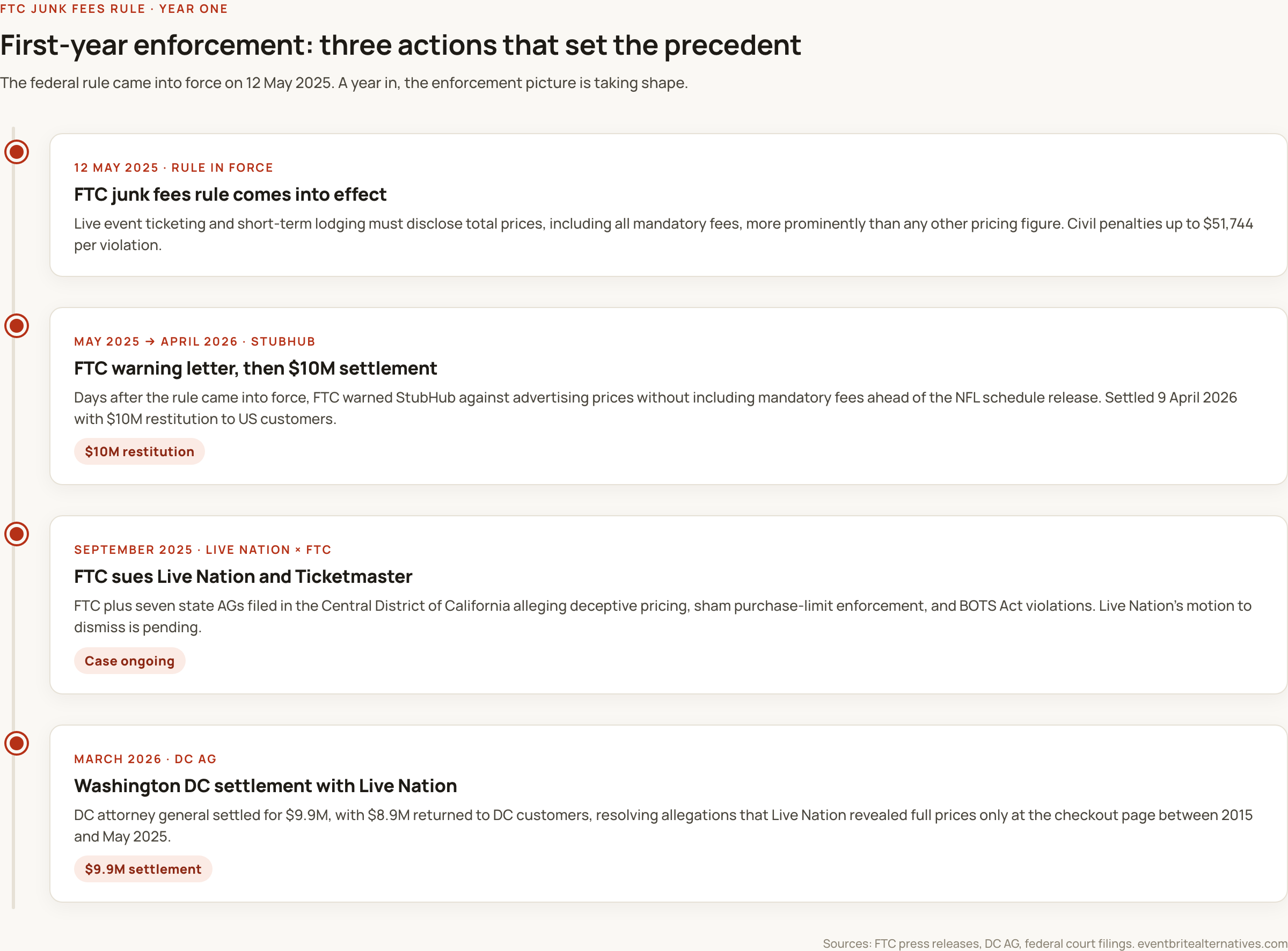
The StubHub warning letter (May 2025) and settlement (April 2026). Days after the rule came into effect, the FTC sent StubHub a warning letter alleging violations and warning against further misrepresentation of ticket prices, ahead of the NFL 2025 schedule release and the high-volume ticket sales that follow it. On 9 April 2026, the FTC announced a settlement requiring StubHub to pay $10 million in restitution to US customers who purchased live event tickets between 12 and 14 May 2025, resolving allegations that the platform had advertised ticket prices without including mandatory fees and had failed to disclose total prices wherever prices were displayed. The settlement amount is modest by Live Nation standards but consequential in two ways: it is the FTC’s first significant enforcement action under the rule, and it establishes a precedent for what compliance failures cost.
The Live Nation / Ticketmaster FTC case (filed September 2025). The FTC, joined by seven state attorneys general, sued Live Nation and Ticketmaster in the Central District of California, alleging that the companies had advertised ticket prices deceptively lower than the prices displayed at checkout, deceived consumers about the enforcement of advertised ticket purchase limits, and facilitated the sale of tickets unlawfully acquired by ticket brokers. The case alleges violations of the Better Online Ticket Sales Act and Section 5 of the FTC Act, in addition to state consumer protection statutes. Live Nation filed a motion to dismiss in January 2026; the FTC has opposed the motion. The case is ongoing and is procedurally separate from the antitrust verdict reached in April 2026.
The DC settlement with Live Nation (March 2026). Washington DC’s attorney general reached a $9.9 million settlement with Live Nation in late March 2026, of which $8.9 million is being returned to DC customers, resolving allegations that Live Nation had been advertising prices that were lower than the actual prices charged at checkout, in violation of DC consumer protection laws. The investigation found that between 2015 and May 2025, Live Nation “revealed the full price only on the checkout page where the amount of costly mandatory fees were disclosed for the first time, after consumers had already invested time and effort in the purchase”.
Three separate proceedings, three sets of findings, all pointing at the same underlying behaviour. The pattern is consistent enough to suggest the regulatory environment has shifted, not just the rule itself.
The state-level surge
The federal rule is only one part of the picture. State legislatures and attorneys general have been moving faster than federal regulators in some respects.
Connecticut, Maryland, Minnesota, New York, North Carolina and Tennessee have all enacted statutes specifically requiring transparent pricing for live event tickets. The state laws generally require that the total ticket price, including mandatory fees, be disclosed clearly and prominently to consumers, broadly mirroring the federal rule.
Maine’s legislation, effective shortly after the FTC rule, mirrors the federal focus on short-term lodging and live event ticketing. California has passed legislation specifically targeting short-term lodging, including the disclosure of resort and similar fees. Colorado enacted a junk fees law on 1 January 2026 that prohibits advertising the price of a product unless the total price (excluding government and shipping charges) is clearly disclosed as a single number. Massachusetts authorises penalties up to $5,000 per violation; Minnesota up to $25,000.
The state-level penalties matter because they are stackable with federal enforcement. A platform that runs afoul of both the FTC rule and a state UDAP (Unfair or Deceptive Acts and Practices) statute can face simultaneous federal and state penalties on the same conduct. Private rights of action under several state laws also create class action exposure independently of regulatory action.
New York City joined the picture in January 2026, when the mayor’s office signed an executive order directing the Department of Consumer and Worker Protection to crack down on junk fees, including through an interagency Citywide Junk Fee Task Force.
The cumulative effect is that compliance is no longer just a federal exercise. A ticketing platform operating across multiple states faces a patchwork of overlapping requirements, with different penalty structures, different scopes (some apply to all consumer goods, others only to ticketing), and different timelines.
What changed for event organisers
For event organisers, the rule has produced four practical effects.
Ticket platforms now display total prices up front. This is the most visible change. Eventbrite, Ticketmaster, StubHub, SeatGeek and most major platforms now display the all-in price including fees, either in the headline ticket listing or in the first stage of the checkout flow. The “starting from $25” listing that landed at $42 by the time the credit card was entered is, in most jurisdictions, now non-compliant.
The “absorb or pass on” decision has become more visible. Most ticketing platforms allow organisers to choose whether to absorb fees themselves or pass them to the buyer at checkout. The rule does not change this choice, but it does mean that when fees are passed on, they have to appear in the headline price. For organisers passing fees, that means the buyer sees a higher up-front number than they used to, which can affect conversion at higher fee levels. For organisers absorbing fees, nothing changes from the buyer’s perspective but the impact on net revenue is more transparent. Either way, organisers can no longer hide fees by deferring them to the end of the checkout flow.
Comparison between platforms is now easier. When every ticketing platform shows the all-in price, organisers can compare what a buyer actually sees on each one. This is most consequential at the higher end of the fee spectrum, where Eventbrite’s 10-13% effective rate on a typical ticket compares unfavourably with Ticket Tailor’s flat fee, Humanitix’s 2-3%, or TicketSource’s bundled 7%. Pre-rule, the comparison was opaque because the headline rate hid the processing fee. Post-rule, the comparison is straightforward. Compare them yourself.
Class action risk has gone up. Plaintiffs’ lawyers have already filed multiple class actions invoking the FTC rule, including one against Pennsylvania ticketing platforms. Even where state statutes do not directly create a cause of action for junk-fee claims, mini-FTC Acts in most states allow private suits for unfair or deceptive practices. The risk profile for any platform with non-compliant disclosure has changed.
What the rule has not done
It is worth being clear about the rule’s limits.
It did not lower fees. The rule requires disclosure of fees, not reduction of them. Eventbrite still charges 3.7% plus $1.79 plus 2.9% processing in the US. Ticketmaster’s service fees are now capped at 15% under the DOJ settlement, but that cap came from antitrust enforcement, not the junk fees rule. The rule’s job was to make pricing visible, not to set the price.
It did not cover most adjacent industries. Live event ticketing and short-term lodging were the only two sectors covered by the final FTC rule, narrowed from the original broader scope that included restaurants, food delivery and transportation. The FTC has indicated it views similar pricing practices in other industries as problematic and has launched a separate rulemaking process for rental housing, but the principle has not been extended formally beyond the original two industries at the federal level. State-level laws have filled some of the gap.
It did not stop drip pricing entirely. The most sophisticated forms of drip pricing involve “optional” add-ons that are technically not mandatory but are presented in ways that make them functionally compulsory (pre-selected checkboxes, default-on travel insurance, opt-out fees). These remain compliant under the rule as long as they are itemised and explained clearly, which leaves room for interpretation. Enforcement of the line between mandatory and optional fees is likely to be a continuing battle.
It did not solve the secondary market problem. Ticket resale platforms operate under the same disclosure rules, but the larger issues with resale (ticket-broker bot activity, scalper allocation, opaque pricing on the secondary market itself) are not specifically addressed by the FTC rule. The FTC’s BOTS Act complaint against Live Nation, filed in September 2025, is the more relevant proceeding on those issues.
What to watch in the next twelve months
Three things to keep an eye on.
The state patchwork is going to keep expanding. More states are introducing junk fees legislation in 2026 sessions. The compliance environment will become more complex rather than less, and the chance of a ticketing platform falling foul of one state’s specific rules while remaining compliant federally is non-zero. Platforms that operate nationally have to engineer for the most restrictive jurisdiction.
The FTC’s Live Nation case is moving. The motion to dismiss is pending. If the case proceeds, it will produce another round of evidence and findings on Live Nation’s pricing practices that will be referenced in future enforcement against other platforms. The case is the federal counterpart to the state-led antitrust case Live Nation has already lost, and a loss in the FTC case would be procedurally separate but substantively reinforcing.
Class action volume is likely to rise. The combination of clear federal rules, private rights of action under state UDAP laws, and an enforcement-friendly environment is a near-perfect setup for class action litigation. Platforms that have not invested heavily in compliance review since May 2025 are exposed.
The wider direction of travel
The junk fees rule is one part of a broader regulatory shift toward price transparency that is genuinely changing how consumer markets operate. The combination of federal rules, state legislation, AG-led enforcement and private litigation is producing a compliance environment that did not exist five years ago.
For event organisers, the most useful response is the same as it has been throughout this series of regulatory changes: know what you actually pay, know what your buyer actually sees, and pay attention to where the regulatory direction is heading. The direction is toward more disclosure, more comparison, and less tolerance for fees that appear only at the final step of checkout. Platforms that align with that direction will have an easier time of the next regulatory cycle than platforms that do not.
The rule has not transformed the industry. It has, however, established a baseline expectation about what a ticket price disclosure should look like, and that baseline is now spreading. For a regulatory intervention that took two years to finalise and applies to only two industries, that is a meaningful start.