Live Nation lost. What the antitrust verdict means for independent ticket organisers
A Manhattan jury found Live Nation and Ticketmaster liable on every antitrust count on 15 April 2026. The five practical implications for organisers running events outside the Ticketmaster ecosystem.
On 15 April 2026, a federal jury in Manhattan found Live Nation and its subsidiary Ticketmaster liable on every antitrust count put to it. The verdict, delivered after a five-week trial and four days of deliberation, ran to 11 pages and found “yes” on 13 separate antitrust liability questions, on 34 specific findings of harm to competition across the 33 state plaintiffs and the District of Columbia, and on a per-ticket overcharge figure of $1.72 on every ticket sold through Ticketmaster at major concert venues.
In plain terms, the largest company in the live event industry has been found by a jury to have operated an illegal monopoly. The case now moves to the remedy phase, where the presiding judge, Arun Subramanian, will decide what to do about it. That decision could include treble damages, civil penalties, and structural relief, up to and including breaking the company in two.
Most coverage of the verdict has focused on the consumer angle. This piece is for independent event organisers: the people running ticketed events on platforms that compete (directly or otherwise) with Ticketmaster’s primary ticketing business. What the verdict actually means for them is more interesting than the headlines suggest.
How we got here
The case was brought in May 2024 by the US Department of Justice and 40 state attorneys general, alleging that Live Nation had monopolised the live entertainment business by controlling concert promotion, artist management, venue operations and ticketing in a way that locked out competitors. The plaintiffs argued that Live Nation controlled 78% of large amphitheatres used by major touring artists and that Ticketmaster handled 86% of primary ticketing at those venues. The legal theory was that Live Nation used its venue control to force artists onto Ticketmaster, and used Ticketmaster’s market position to entrench its venue and promotion businesses.
The DOJ settled with Live Nation on 5 March 2026, requiring a $280 million damages fund, a 15% cap on service fees, and divestiture of 13 amphitheatre booking agreements. A coalition of 33 states and DC rejected that settlement as insufficient and pressed the case to a jury trial. Five weeks later, the jury sided with the states on every question.
Live Nation has indicated it will appeal. The remedy phase is scheduled to play out through autumn 2026, with the states due to submit their remedy requests by the end of May. Some final resolution may come this year; appeals will run for years beyond that.
What the court actually has the power to do
Two remedy paths are now in play. The states want structural relief: a forced separation of Live Nation from Ticketmaster, divestiture of venue holdings, and damages large enough to be felt at the corporate level. Live Nation will argue that the existing DOJ settlement is the appropriate framework and that the court should not impose more than the federal government already accepted.
The structural relief question is the more consequential one. Behavioural remedies (rules about how the merged company operates) have been tried against Live Nation before and failed: the original 2010 merger of Live Nation and Ticketmaster was conditioned on a consent decree, the DOJ found the company violated that decree in 2019, and the 2026 DOJ settlement is essentially a third attempt at the same approach. The senators and state attorneys general pushing for structural separation argue, with some justification, that conduct decrees have not worked. The court will weigh that against the company’s argument that breakup is disproportionate.
What the court cannot do, and this is worth being clear about, is reshape the industry overnight. Even if a structural breakup is ordered, it will be appealed, the appeals will run for years, and any divestiture would take years more to implement. The Microsoft antitrust case in the early 2000s ended with a breakup order that was overturned on appeal and a settlement that imposed behavioural remedies only. The precedent is not encouraging if you are hoping for fast change.
The implications for independent ticket organisers
For organisers running events on platforms other than Ticketmaster, the verdict matters in five practical ways.
The 15% service fee cap is already real. Whatever happens in the remedy phase, the DOJ settlement’s 15% cap on Ticketmaster service fees is now in effect. That number is well above what most independent platforms charge (Ticket Tailor’s flat fees work out to under 5% on most ticket prices, Humanitix to 2.1% plus a fixed amount, TicketSource to 7%), so it does not change the competitive position of those platforms directly. What it does is establish a regulatory ceiling. Future arguments about ticketing fees will increasingly anchor to that 15% number, which is useful editorial ground for any platform positioning on price transparency.
Universe (Ticketmaster’s self-serve subsidiary) is now operating inside a defendant. Universe is the part of Ticketmaster that competes directly with independent platforms like Eventbrite and Ticket Tailor for independent organiser business. The verdict does not specifically address Universe, but the parent company is now a court-determined monopolist navigating a remedy phase. For independent organisers currently using Universe, this is at least worth thinking about in the context of platform stability and product roadmap. For organisers considering Universe, the legal uncertainty around the parent company is a new factor that did not exist a month ago.
The verdict establishes that overcharging happened. The jury fixed the per-ticket overcharge at $1.72 on every ticket sold at major concert venues. That is a court-determined finding rather than an allegation, and it strengthens every other case (FTC, state, class action) that depends on the same underlying behaviour. There are at least three other active legal proceedings against Live Nation and Ticketmaster, including the FTC consumer-protection case filed in September 2025 and a certified class action in California that has calculated potential damages of $688 million (over $2 billion after automatic trebling). The verdict makes those cases easier to win.
Sports ticketing may be next. The Manhattan verdict’s market definition was specific to concerts and large amphitheatres. Several legal analysts have noted that this leaves the door open for a parallel wave of sports ticketing litigation, where Ticketmaster’s market share is similarly concentrated. If those cases come, the competitive landscape for sports event ticketing could open up in ways that have not been possible in a generation.
Competition is no longer just a marketing claim. For years, independent ticketing platforms have framed themselves as alternatives to a dominant incumbent, with arguments about fees, ownership, and data sovereignty doing most of the work. A federal jury has now agreed that the incumbent was operating illegally. That changes the texture of the conversation. The case for switching is no longer “we are cheaper and friendlier” but “the largest competitor in our market has been found liable for monopolisation.”
What is not going to change quickly
A few qualifications are worth flagging.
The verdict does not mean Ticketmaster is going away. The company processes the majority of tickets at major venues in the US and operates at significant scale internationally. Even a structural breakup would produce a still-large Ticketmaster as a standalone company. Independent platforms compete in a slightly different segment of the market (self-service, independent organisers, smaller venues) where Ticketmaster’s market dominance has always been less complete.
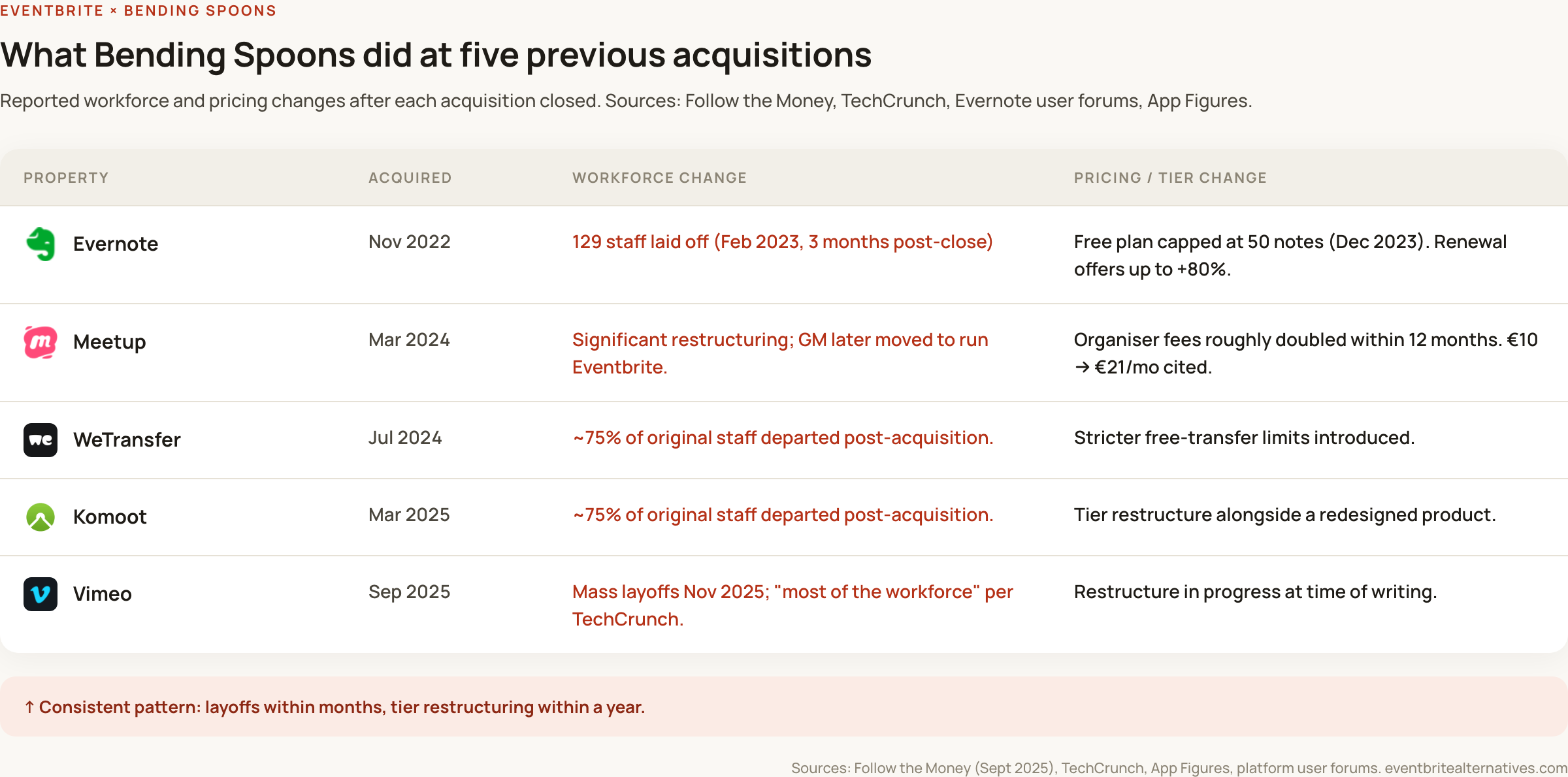
The verdict also does not directly address the Eventbrite-adjacent segment of the market, where independent organisers actually live. Eventbrite is a different company, recently sold to Bending Spoons, operating in a different competitive layer. The independent self-service ticketing market has its own competitive dynamics, including the pricing and feature questions that organisers actually care about. Those questions are not resolved by this verdict.
And the appeals process is going to be long. Live Nation has already filed motions challenging the verdict and the damages calculation. The remedy phase will produce a separate set of appealable decisions. The final shape of the live entertainment industry post-verdict is not going to be visible for several years.
What to do now
For organisers, three practical takeaways:
First, if you sell through Ticketmaster, Universe or any Live Nation-affiliated platform, watch for product and pricing changes. Companies under remedy pressure tend to change behaviour. Some of the changes will be customer-facing improvements (the 15% fee cap, more transparent pricing). Others will be cost-cutting that affects platform stability or support. Worth monitoring rather than assuming continuity.
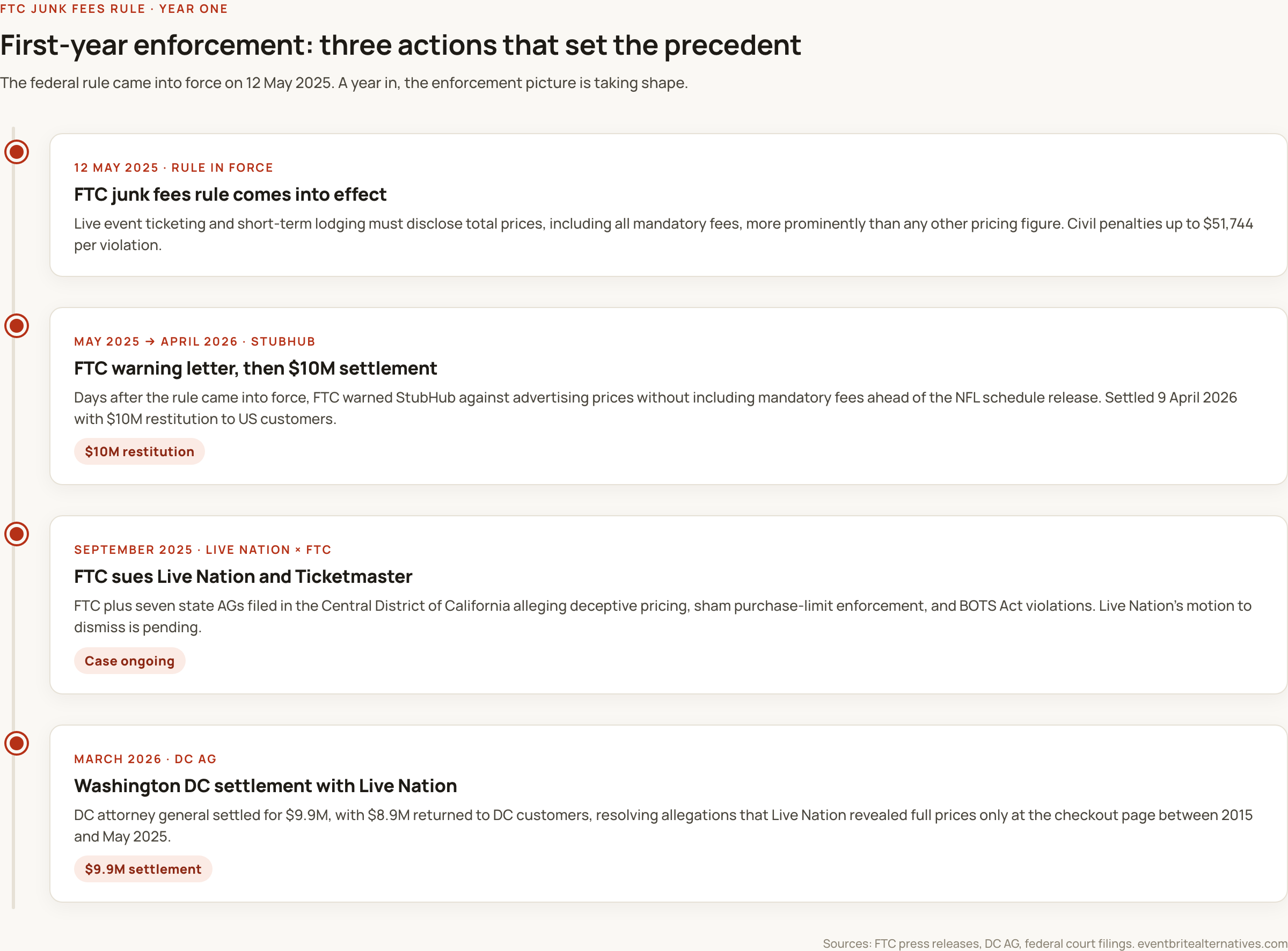
Second, use the moment to evaluate alternatives properly. The independent ticketing market in 2026 is more competitive than it has been at any point in Eventbrite’s or Ticketmaster’s history. The Bending Spoons Eventbrite acquisition, the antitrust verdict, the FTC junk fees rule and StubHub’s IPO have all happened inside an eighteen-month window. The market is moving. Comparison work that was true a year ago is partially out of date. Re-run the numbers.
Third, the moral argument for choosing independent platforms is now structurally easier to make. For organisers thinking about how to communicate platform choice to their audience, “we use an independent ticketing platform” has a different weight when the dominant platform has just been found by a jury to be operating illegally. That is not a fact platforms or organisers need to weaponise, but it is a fact.
The verdict is one of the most significant antitrust decisions in tech this decade. Its full effects will play out over years rather than months. For independent ticket organisers, the most useful response is the same as it usually is: know what you actually pay, know what your alternatives look like, and pay attention to the direction the industry is moving in. That direction, at least for now, is decisively toward more competition rather than less.