Ticketmaster cut 350 jobs the day after record earnings. The gap is the story
Live Nation reported $3.8B Q1 2026 revenue on 5 May. The next day, Ticketmaster cut 350 engineering, product and design jobs across 25 countries. What the AI-driven restructure means for organisers, particularly Universe customers.
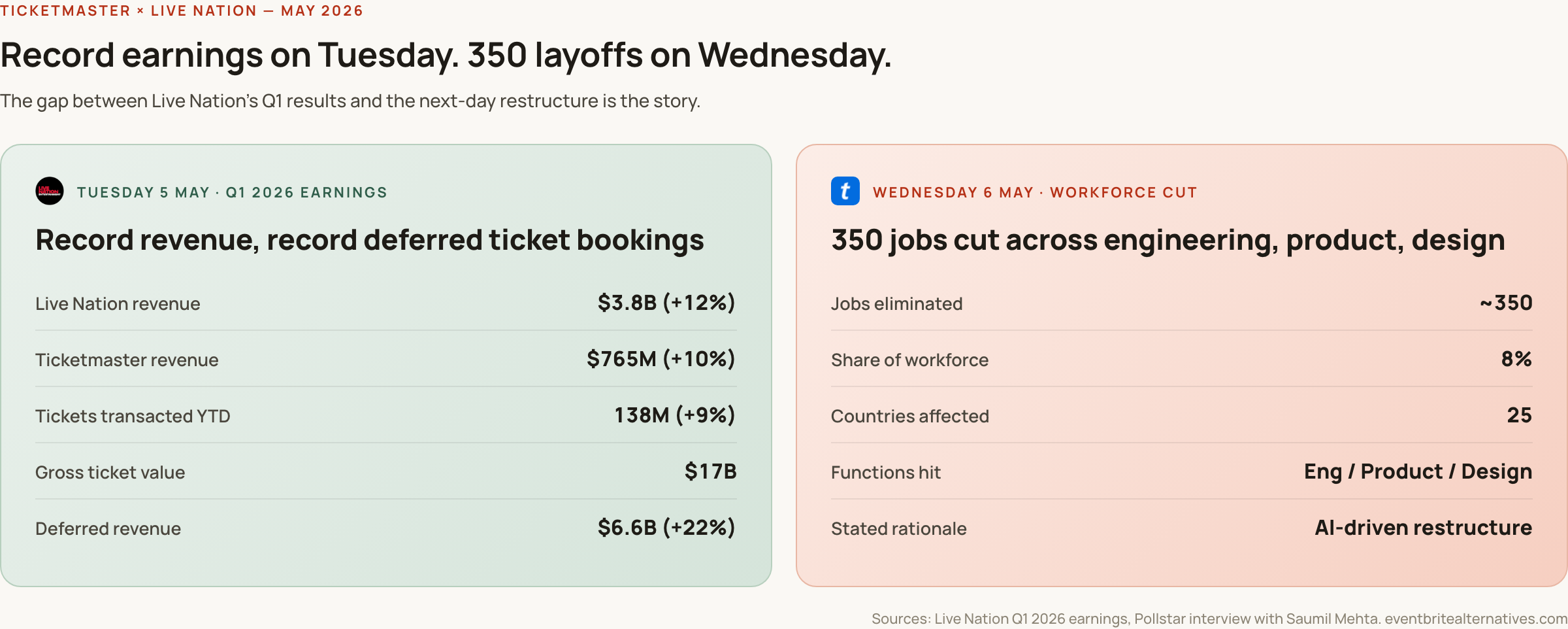
On 5 May 2026, Live Nation reported first-quarter earnings that read as a victory lap. Revenue at the parent company rose 12% year-on-year to $3.8 billion. Ticketmaster’s own revenue grew 10% to $765 million. The company had transacted 138 million fee-bearing tickets through the end of April, up 9%, on $17 billion of gross ticket value. Deferred revenue across Concerts and Ticketmaster reached $6.6 billion, a 22% increase and the largest in company history. The CEO, Michael Rapino, talked about an “increasingly digital and AI-driven world” and the strength of demand for live entertainment.
The next day, Ticketmaster cut approximately 350 jobs, eight per cent of its global workforce, across 25 countries.
The sequence is what generated the headlines: strong earnings on Tuesday, mass layoffs on Wednesday. The standard reading is that companies cutting staff while reporting record revenue are doing so for reasons that have less to do with financial necessity than with strategic positioning. In Ticketmaster’s case, the company has been unusually direct about what those reasons are. The layoffs are part of an AI-driven restructuring led by a new president, against the backdrop of one of the most active legal and regulatory environments the company has ever faced. For event organisers who run ticketing through Ticketmaster, or through its self-service subsidiary Universe, the question is what this means for the platform they actually use.
What was announced
Saumil Mehta, Ticketmaster’s Global President, told Pollstar that the cuts targeted engineering, product and design teams specifically. His framing: “The purpose of these cuts is stronger prioritization, especially in engineering product and design. That comes with flattening layers, consolidating ownership, changing how teams are structured and ensuring that we put more energy behind specific initiatives.”
The detail that matters is the function mix. Engineering, product and design are the disciplines a software company normally protects in a cost-cutting exercise. They are the people who build and improve the product. Cutting them first does not look like trimming back-office overhead. It looks like restructuring around a different product roadmap, which is consistent with what Mehta has been describing publicly.
On 15 April, three weeks before the layoffs, Mehta delivered a keynote at the Pollstar Live! conference titled “From Big Tech to Box Office: AI’s Next Chapter In Live”. His thesis was that AI is becoming “a new utility” in the way electricity is, that this changes how commerce platforms should be built, and that Ticketmaster’s existing organisational structure was not designed for the change.
Mehta came to Ticketmaster from Square in November 2025, replacing Mark Yovich, who moved to a chairman role. Mehta spent nine years at Square as Chief Product Officer and Head of Business, working on Cash App, Afterpay and TIDAL. His pitch to internal teams, paraphrased, is that he learned at Square how to scale commerce platforms in the age of AI, and he is now applying that approach to Ticketmaster. The layoffs are the most visible part of that approach so far.
Asked by Pollstar about the timing, with strong earnings published one day earlier, Mehta said: “Strong performance reflects the past, and this is about what are we doing to set ourselves up for the earnings report 12 months from now, 18 months from now, 24 months from now.”
The financial and regulatory pressures behind the move
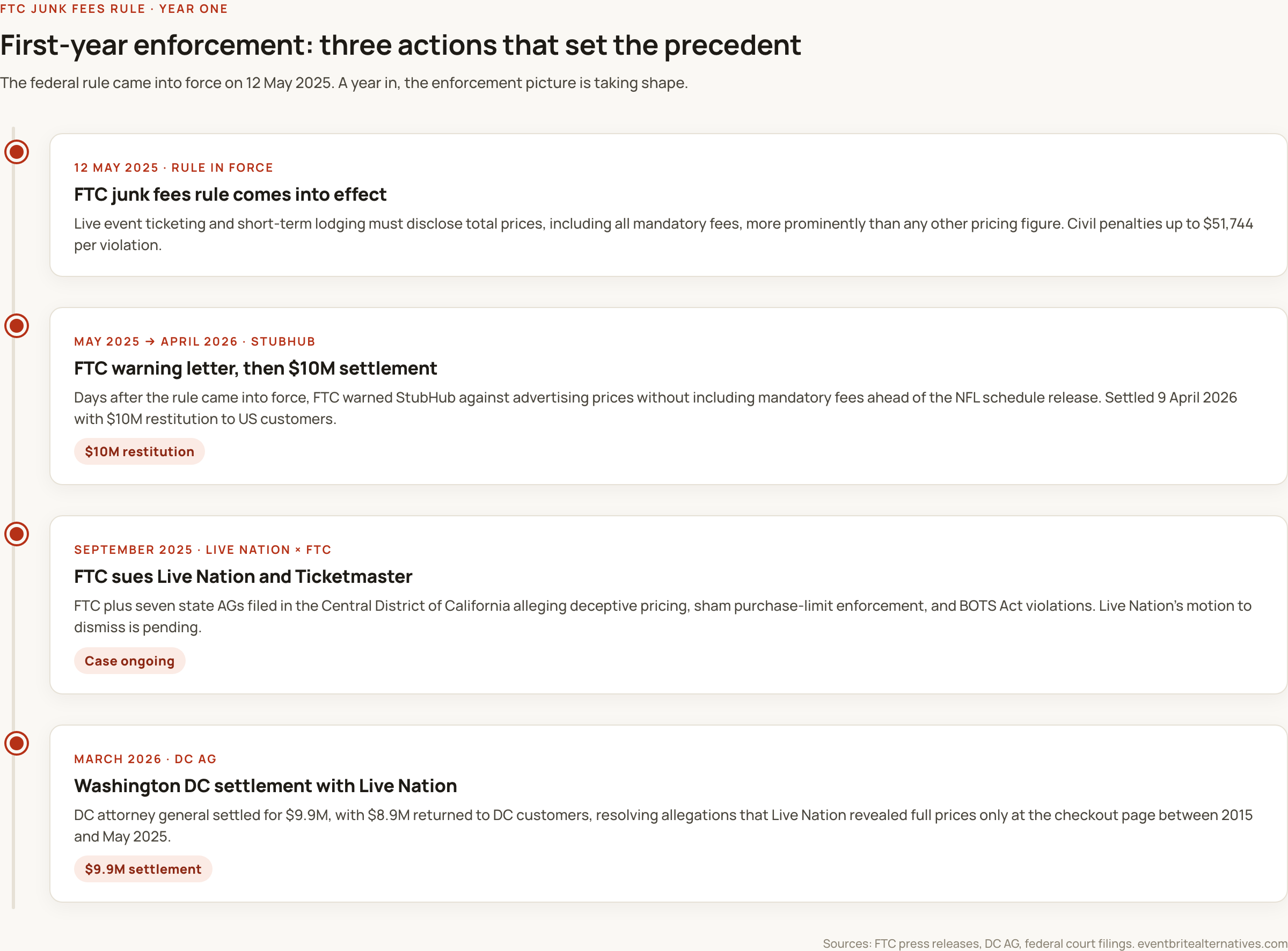
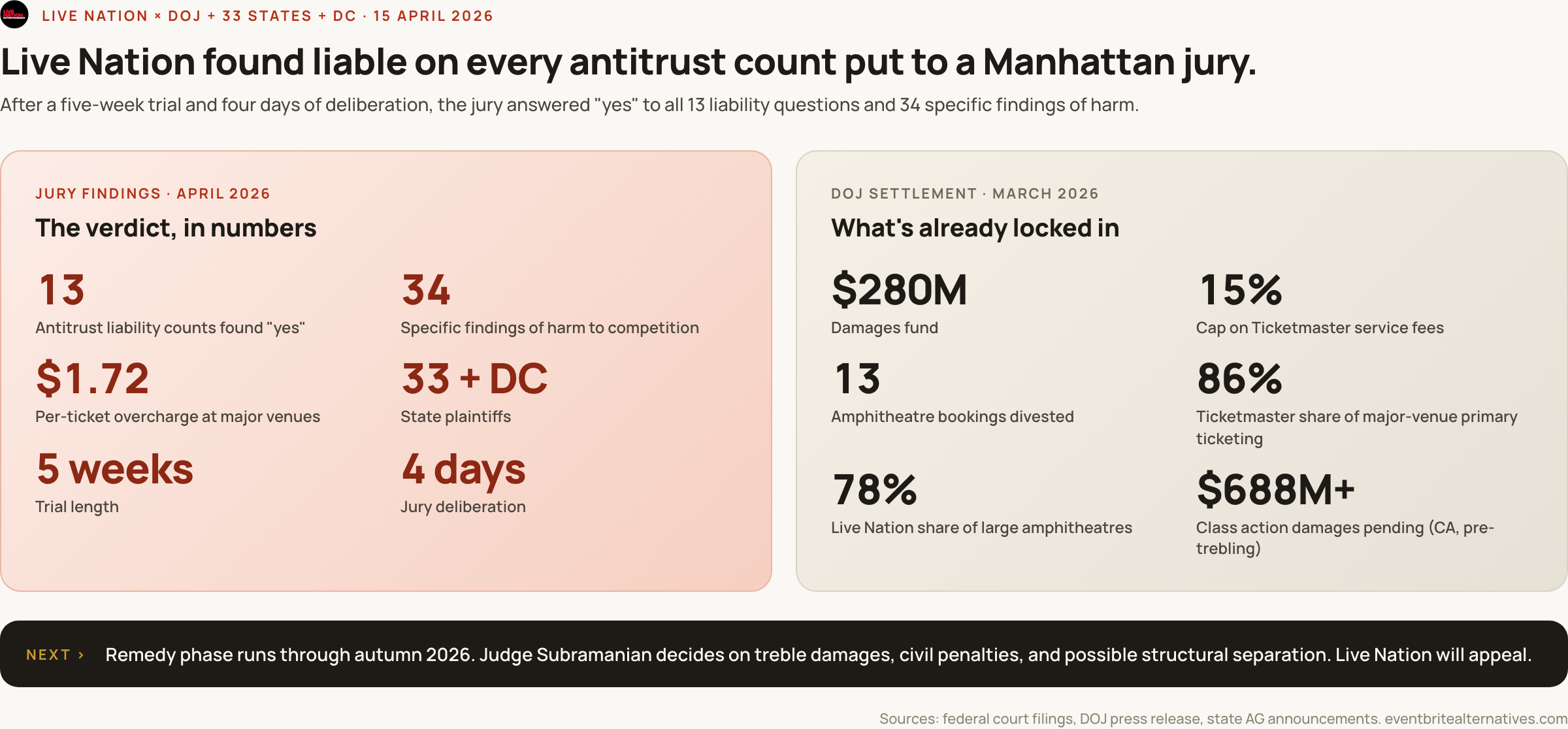
There is more context worth knowing. Despite the strong revenue numbers, Live Nation reported a $371 million operating loss for the quarter. The company also booked a $450 million legal accrual tied to ongoing litigation. The contradiction (high revenue, large operating loss) reflects cost structure that has not scaled efficiently, plus the legal bills the company is now stacking up against the antitrust verdict, FTC junk fees case, and DC settlement.
Set against the legal situation, the layoffs read partly as cost discipline at a moment when the company is staring down significant settlements. The 15% cap on service fees from the DOJ settlement is a structural constraint on per-transaction revenue. The $280 million damages fund is a known cost. The 13 divested amphitheatre booking agreements remove preferred relationships. The April antitrust verdict opens the door to treble damages and potentially structural relief. None of this is fully priced into the current cost base.
It is also worth noting what was not cut. According to Pollstar, the executive leadership team is unchanged. The cuts hit rank-and-file engineering, product and design staff and contractors. The financial logic of removing 350 mid-tier salaries while preserving executive structure is what it usually is in these situations: a calculation that the senior layer is what drives strategy, and that the work the junior layers were doing can be done with fewer people, AI tooling, or both.
What this means for organisers
Ticketmaster is not most independent event organisers’ day-to-day platform. The vast majority of independent organisers run on Eventbrite, Ticket Tailor, Humanitix, TicketSource, TicketSpice or one of a dozen other self-service platforms. Ticketmaster’s direct customer base is concentrated at the larger end of the venue market: arenas, amphitheatres, major touring acts.
There are two channels through which the layoffs matter to a wider organiser audience, though.
Universe. Ticketmaster’s self-service subsidiary, Universe, competes for the same kind of independent organiser business that Eventbrite and Ticket Tailor serve. Universe was not specifically named in the layoff announcement, but it operates inside the parent company’s restructuring perimeter. The product, engineering and design teams now being consolidated and prioritised at the Ticketmaster level will affect what gets built at Universe and what does not. For organisers currently using Universe, this is worth watching: platform restructurings tend to produce visible product changes, both good (faster iteration on priority initiatives) and bad (deprioritisation of features that do not fit the new roadmap, slower support response times, reduced engineering coverage for edge cases).
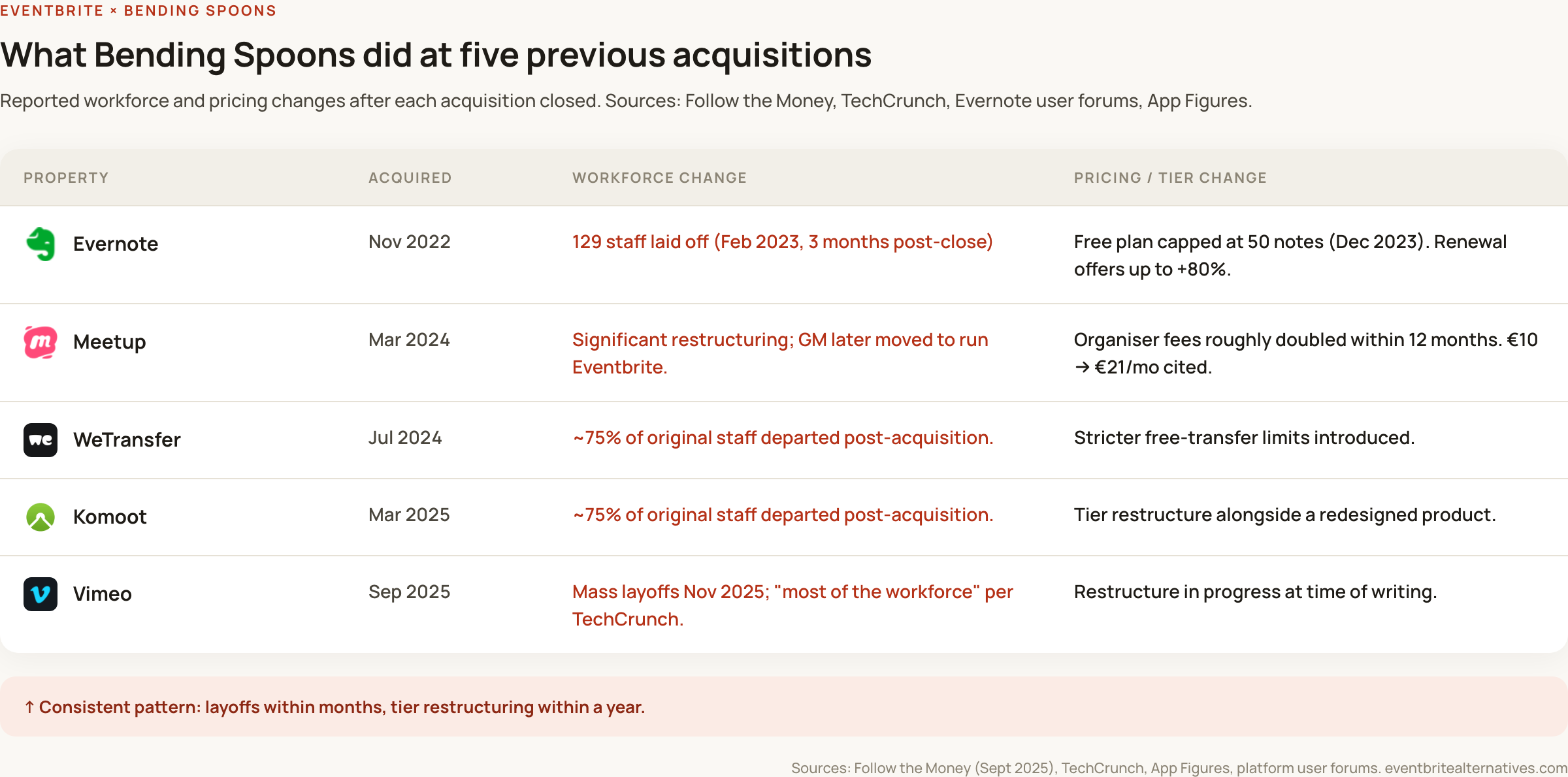
The broader pattern. Ticketmaster’s restructuring is part of a wider industry pattern of large platforms reorganising around AI. Eventbrite is in the early stages of a Bending Spoons-led restructuring that is likely to follow similar lines. Other large ticketing platforms have already conducted AI-driven restructurings of their engineering and product teams. The pattern matters because it tells you something about where major platforms are investing and what they are deprioritising. AI investment is concentrating on a few specific surfaces: search and discovery, pricing optimisation, fraud detection, and (perhaps most consequentially) customer service automation. Areas that do not benefit from those investments are being reduced.
For organisers, the practical implication is that the support experience on major platforms is likely to become more automated and less human-staffed over the next 18 to 24 months. That is a quiet but real change. The platforms that retain genuinely human customer service as a differentiator (Ticket Tailor’s 24/7 support, Humanitix’s named support team members) will find that differentiation harder to copy as larger platforms move in the other direction.
What Ticketmaster says it is building
Mehta’s public statements give a reasonably clear picture of the product direction. The investment areas he has named:
- Mobile-first experience for fans discovering and purchasing tickets
- AI-driven search and pricing transparency, partly in response to the FTC junk fees rule and the antitrust verdict
- Fraud detection at scale, building on lessons from payment platforms
- Inventory and seat availability surfacing, with revamped purchasing flows that show pricing earlier in the process
This is a credible product roadmap. Whether it benefits independent organisers (who mostly do not use Ticketmaster) is a separate question. The improvements are largely consumer-facing rather than organiser-facing. The investment is in the buyer experience, partly because that is where the company’s regulatory exposure is largest and partly because it is where AI can be most usefully applied. Organiser-side improvements are not the headline.
What this does not change
Worth flagging what the layoffs do not mean.
They do not mean Ticketmaster is in financial trouble. The numbers do not support that reading. The company is generating substantial revenue, growing transaction volume, and sitting on the largest deferred revenue balance in its history. The layoffs are a strategic restructuring, not a survival measure.
They do not mean platform reliability is at risk in the short term. Ticketmaster’s infrastructure is large, well-funded and engineered for high-traffic events. The teams cut were not, by all reports, the people running the core ticketing platform on event night.
They do not change the antitrust trajectory. The remedy phase of the April verdict will play out on its own timeline, regardless of how the company chooses to organise itself internally.
And they do not mean AI is going to magically replace 350 engineers. That is not how this works. The realistic outcome is that Ticketmaster will operate with fewer engineers, lean more heavily on AI tooling, build more in-house and use fewer contractors, and ship product faster in specific prioritised areas at the cost of slower iteration in deprioritised ones.
The wider signal
The single most useful thing in Mehta’s framing is the line about strong performance reflecting the past. He is right. Ticketmaster’s revenue growth in Q1 2026 reflects ticketing decisions and event contracts made months and years earlier. The layoffs are an attempt to reshape the company for a different competitive and regulatory environment, one that genuinely is changing.
The antitrust verdict, the FTC junk fees rule, the DC settlement, the rise of independent ticketing platforms, and the broader regulatory direction on price transparency all point at a market where the historical advantages of incumbent scale are slightly less protected than they used to be. Major platforms are reorganising around that reality. The companies cutting engineering staff today are betting they can serve a larger market with less labour, using AI to fill the gap, in time for the next two or three years of competitive pressure.
For independent event organisers, the most useful response is to keep doing what was already useful: knowing your platform’s pricing structure, knowing what your alternatives offer, and paying attention to where major platforms are investing and where they are not. The shift to AI is real, but it is not a shift away from caring about cost, support quality and feature roadmap. It is a shift in where those things will be delivered from. The decisions that matter for organisers are still made on the basis of what works for their specific event, not on the basis of who has the most impressive AI keynote.